
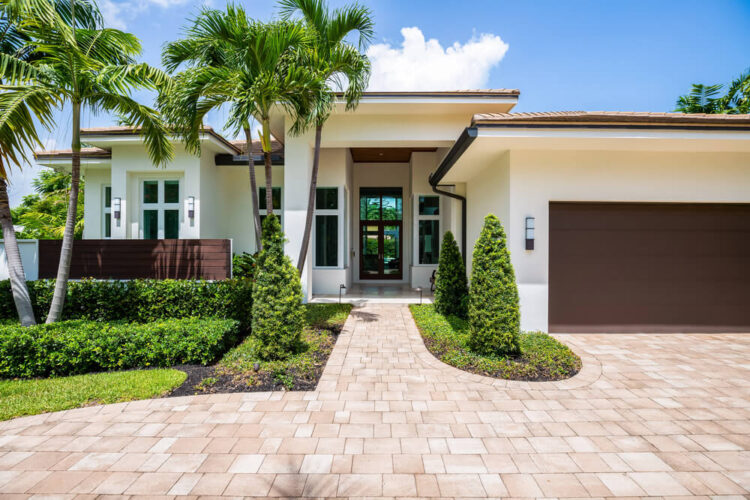
 This is the last post in our series on The Villages (TV), Florida.
So far we’ve covered what there is to like and not like about TV as well as how to make the most of a Lifestyle Trip there.
Today we’re going to assume you eventually decide that you want to buy a place in The Villages…and we’re going to share details on how to do that.
I’ll begin by telling you that buying a house in The Villages is a unique process that’s different from traditional real estate in many ways.
Here’s a step-by-step guide, whether you’re purchasing a new home or exploring resales.
Step 1. Decide How You’ll Buy: New vs. Resale
The Villages has on-going construction of homes. No sooner does a new piece of land get announced as part of TV and either the lots are for sale or new homes will start popping up and will be selling soon.
In addition, there are people selling their existing homes, either to buy a different home in TV (the lore there is that the average Villager buys three homes there during their time living in TV — we met several people who had done so!) or to move out of TV (like we did).
So your first decision is to decide what to buy. Your choices are:
- Land upon which you’ll build a home
- A newly constructed (already built/spec) home
- A resale property
TV doesn’t have a publicly stated method for when they sell land versus when they put homes on the land and then sell them (I’m sure they do internally), so if you’re looking at areas to have a new home, you could face either option.
So let’s cover some basics:
- Land Sales: Only available through The Villages Sales & Marketing (their agents) — they don’t use the MLS, and outside realtors can’t represent you. There’s one agent: the person selling you the home.
- New Homes: Same rules as for land.
- Resale Homes: Available through both The Villages Realty and independent MLS realtors (you will need a non-Villages realtor here).
Let me pause a bit to explain the two systems for reselling homes in TV.
When someone wants to sell their home in TV, they can list it on their own (of course) or hire an agent and go through one of the listing services.
In most places across the US, there’s only one listing service, the MLS. But in TV, for previously owned homes, there’s the MLS plus the VLS.
If someone lists on the MLS (which is exclusive – you can’t list on both services), it’s through a “regular” real estate agent that’s not affiliated with TV in any way. That home will only be seen by people searching the MLS, which agents working for TV will/can not do.
If someone lists on the VLS, it’s through a real estate agent employed by TV. That home will only be seen by people searching the VLS, which agents not working for TV can’t access.
I’ve seen different statistics, but the common sentiment is that resale homes are 50/50, with half on the MLS and half on the VLS. But I’ve also heard that it’s more like 60/40 favoring the VLS.
So as a seller, you will need to decide which service and realtor you think is better. As a buyer, if you want to see all currently owned homes for sale in TV, you need two agents — one for the MLS and one for the VLS. Told you it was different. hahahahaha.
Which you choose is obviously a personal choice made for various reasons. We went with the VLS because:
- We knew our agent and liked/trusted her.
- We felt the marketing the VLS offered was better.
- We thought the details/sales process would be easier.
The above may or may not be actually true (is the process really easier with the VLS? It’s hard to tell) but those were our opinions. And I can state that our selling process was very smooth, so it worked out well.
In this post I’m going to focus on buying new construction as it’s the process that’s different than resales. Other than the above, buying a resale unit in TV is pretty much like buying a home anywhere else.
But buying new construction is a different process (it’s the same process for buying land…in most respects.)
2. Meet with a Villages Sales Rep
Since you’re buying a new home (or land) you will need a sales agent from TV.
You can either find one from word-of-mouth (here’s who we used) or you can go to a sales office and be assigned one at random. If you take a Lifestyle Preview Trip you’ll also be assigned one.
The agent will be able to show you both homes and land that are coming on the market as well as explain details like amenity fees, bond specifics, maintenance responsibilities, and deed restrictions.
Some rough estimates on these are as follows:
- Bond: covers infrastructure cost (roads, sewer, etc.), typically $30K-$50K+. Paid off over 20–30 years or upfront. In the past there was no reason to pay off upfront as the interest rates were so low. That may have changed now.
- Amenity Fee: ~$195/month for recreation access. The bargain of the century.
- Property Taxes: Typically $1,500–$4,000/year depending on home value. Our annual taxes were $5,500 but also included our annual bond payment and some services for TV (yes, the local government there collects some money paid to TV.)
- Maintenance Assessments: Cover landscaping, irrigation, etc. in some areas. These are included in the $5,500 above. I think it was a few hundred dollars a year.
3. Choose a Home Style
The Villages offers several home styles:
- Patio Villas (smallest, lowest cost)
- Courtyard Villas
- Designer Homes (most popular)
- Premier Homes (larger, luxury)
- Cottages, Verandas, and Bungalows (in select areas)
These vary in size, yard features (some have fences), number of garage spaces, etc.
It would take me several posts to explain all of these so my best tip for finding what you want is to talk to your agent to narrow down the list, then get out and see models/upcoming homes that are in the styles you think you might like. Then you can narrow your options more from there.
FWIW, your home will be in an area where all the home styles are the same (all designer homes together, all patio villas together, etc.) There are multiple designs within each style, so the areas aren’t full of exactly identical homes, but the areas are full of the exact style of homes, so you’ll be living around others who have the same type of homes together as you do.
Once you know what type of home you want, you can then look at lots where these types of homes are being built or empty land parcels that will fit the type of home you want.
We knew we wanted a designer home and we had 4-5 models of designer homes we liked. We were only looking at spec homes at that point (since TV was not selling land then). So we looked in the village we wanted (Richmond) and identified homes we liked in locations we liked.
We shared this with our realtor and told her we’d be interested in any of these home/location combinations and if they came up for sale, we wanted to make an offer. We had about 15 total options that we gave her.
This is key — having more options than one — because as you’ll see, it’s very hard (and rare) to get your first choice.
Let me pause a moment before we get into the buying process to talk about the importance of location. It’s a fundamental rule of buying real estate that “location, location, location” is vitally important. And there’s nowhere that’s more true than in The Villages.
Some of the location decisions you’ll want to consider:
- What village do you want to be in (and how close is that village located to things you want to do – a town square, a golf course, a pool, the pickleball courts, etc.)?
- Where inside each village do you want to live (close to amenities or in a far away, quieter location)?
- Do you want a special view (of a park, nature preserve, water, golf course, etc.)? FYI, these are more expensive than places with “kissing lanais” where your lanai has a view of another home’s lanai.
- Do you want your home to face a certain direction (facing north in TV is popular but so is south — so your lanai faces north)?
These are some of the main considerations you’ll need to decide upon. They will be vital to your pleasure in owning the home as well as what your resale value will be.
4. Buy (or try to buy) a Home
Here’s where things get wacky.
In most of America a house goes on the market, and people place offers based on the demand for that place.
If many people want it, a bidding war may ensue and the seller could get well over asking price.
If hardly anyone wants it, the seller may have to take an offer below asking.
The Villages is different. Here’s how their process works:
- The sales agents know which homes (or pieces of land) are going to be up for sale soon and those are the ones they show potential buyers.
- When these homes are ready to be sold, The Villages give the agents notice that they will be released for sale at 8 am the next day. The Villages also tells the agent the price.
- Just to note, the price is the price. There’s no over-bidding or under-bidding. If there’s demand, the house will be sold for that price. If there’s no demand at that price (which is rare) the home is not sold.
- Once the agents get word that certain homes are to be put up for sale the next day, they notify their buyers and confirm whether or not the buyers want to try and buy the houses available (usually only 1-2 homes come on the market in any given day).
- At 7:59 am the next morning, the agents with interested buyers (which include potential home owners as well as investors) are sitting in front of their computers refreshing them like crazy. Once the clock hits 8 a.m., the homes go live and the first one to reserve it gets it. Then others start to queue behind them. (You think I’m making this up, but I’m not. It’s literally a race to be first as it’s a first come, first served system.)
- Whoever gets the reservation then has either two or three hours (I think it’s two) to commit to the deal. If they don’t, the offer goes to whoever was second and they have two or three hours. This goes on down the line until someone commits to it (which is usually the first person).
It’s rare to get first place on your first try as it’s still pretty competitive, especially for great homes in great locations. Sometimes no one makes an offer on a home but that is rare. What is more common is that there’s a big line for most homes (we had one couple tell us they were #45 on the list for a home) and it takes several tries to get a place (it took my dad five tries).
So you need to have several homes you like because odds are you won’t get the first one you try for.
Also, you don’t know when any given home will come up, so your 4th choice may be the first for sale. Do you try for it knowing it’s hard to get anything you like or do you wait for your first choice knowing it’s highly unlikely you get any one house? My dad’s fifth try happened to be his top choice, but he tried for numbers 2-5 in previous attempts and was willing to buy any of those.
Anyway, once you commit, you have to make a deposit on the home to hold it (I think it’s within 24 hours) and I believe you also have to sign something to lock it in.
5. Secure Financing or Prepare for Cash Purchase
How do you plan to pay for the house?
Cash purchases are common. I’ve heard/read that roughly 50-60% of sales are in cash, though I’ve also heard that’s declined a bit over the past couple years.
If financing, get approved through your lender or use The Villages’ recommended mortgage providers (if you weren’t pre-approved).
6. Design your home.
If you bought land, you will eventually get an appointment to meet with designers from TV to design your new house. You’ll work with them over the course of a couple days to pick everything in your house (within limits), set prices, and firm up details.
Then you commit to the plan and all the specifics. But be sure you really think things through as once you commit, some things are locked in and any other things that can be changed by paying a fee.
Once it’s all set, TV develops a time table to build your home.
Of course if you buy a spec home, everything is already decided for you. Homes up for sale are roughly 90% done, so in the 30 days or so before your closing, the builder will finish the home completely.
7. Complete your pre-closing tasks.
There are a few things you need to do as the home is being finished, namely setting up your utilities and taxes. The ones for our house in TV were:
- SECO Energy — Electricity
- TECO — Gas
- Village Community Development District — trash, water, taxes, and bond payment
- Xfinity — Internet
You’ll also want to hire a lawn mowing service in advance (if you want one).
8. Conduct a Walkthrough
Prior to closing, you’ll do a “blue tape” walkthrough to note paint issues, scratches, things unfinished or broken, etc. Then, as you go to close/sign the paperwork, the builder sends in a gazillion workers to fix any noted defects prior to closing.
I can’t recommend enough doing this in person. We closed remotely and when we got to the house, it was a mess…with a lot of fixes that needed done.
They fixed it all (we walked through with the builder when we got to Florida a week after we closed) but it took months and we had to live through it in the house — including the entire interior being repainted! It was a nightmare. If we had been there to close in person, we could have avoided a lot of that by not closing until it was all done.
9. Close on the Home
Closing takes place at The Villages title company or a recommended local office. Your sales representative will give you details on that in advance.
Be sure to bring your IDs and certified funds if not wired. We wired ours in advance.
At closing you will receive keys to the house, garage openers, and resident ID forms.
10. Register and Move In
You will pick up your Villages ID at a local sales office—this gives you access to all amenities.
Move everything into your new place and begin enjoying your new lifestyle!
We moved in with almost nothing and spent the next couple of months furniture shopping. I would not recommend that.
I would also not recommend bringing everything you have from your last house either as odds are 1) it won’t fit and 2) it won’t be the “Florida style” you want. So many second-hand stores around TV are filled with “up north” furniture that it’s almost a running joke about people bringing their stuff with them.
Instead, I’d recommend bringing a sub-set of what you own — items that will fit your new house and new style. Then you can fill in the rest with shopping. I wish we had done that, but some people have to learn the hard way! Ugh!
11. Customize the House If You Want
You might be shocked to discover what homes in TV generally come without — things you might want to add. Here are some popular/common changes/add-ons to homes:
- Install ceiling fans with lights — Most homes in TV do not come with this combination. They generally have fans, but not lights on the fans, so many people add those.
- Landscaping — Spec homes come with basic landscaping and I’d say 10-20% of people upgrade their yard in some way. Just be sure you get approval to make those changes in advance (from the architectural review committee).
- Gutters — Homes don’t come with these (believe it or not) but they are pretty easy to add. We did ours within the first few months we lived there.
- Enclose lanais and/or front entryway — Some people like to make their lanais more into a room, so they enclose them in glass (there are a million possibilities of what this could look like). Others add screens to their from entryway (not doors but the large arched area several feet from the door. We did this and it really cut down on the bugs around our door. Plus it was good for a cross breeze on the three days a year where it;s cool enough to do that.
- Garage floors — Many have their plain garage floors sealed with a decorative material to make the garage look prettier as well as make the floor easier to clean. We did this (and would do so again) plus we had our lanai floor painted (which we’d also do again).
- Pool — A small portion of the people add pools to their homes. My advice is don’t do it. It’s expensive and difficult to do, costs a pretty penny to keep running, and you have a gazillion pools that someone else takes care of (and which you already pay for) at your disposal. But the biggest reason not to do it is that almost everyone who does told us that after a year or so they hardly use it and wish they had never added it.
A Few More Things
To wrap up, there are a couple other things worth mentioning about buying a home in TV…
The first is that you can’t sell the home for a profit in the first year. This is a rule that keeps people from winning the home lottery described above and then selling immediately for a profit. This is because…
Second, there is usually a big profit once the home is sold by the original owner. TV keeps the cost of homes relatively low (remember, they control the initial selling prices) when market prices are actually much higher. So most sellers do quite well even when holding their home for a short period of time.
For example, our house increased roughly $160k in less than two years.
And just to be perfectly clear, note that I said you can’t sell the home “for a profit” in the first year. You can sell the home in the first year (which we saw some people do when one spouse got sick or died) but you just can’t make money on the sale. If you sell within the first year, you get back what you paid for it plus capital improvements, but anything above that goes back to TV.
Many investors buy homes and then either rent them or let them sit for 10 months or so. Then they put them on the market and set a closing date anytime after the one year mark.
Well, that’s about all I can remember about buying a new home in TV. Do you have any questions or need anything clarified?

Great Article! It’s very helpful information. I’m thinking about moving to TV in the future to save on taxes especially when RMD payment starts. Quick questions:
1. How does the commission work when you sell your house in TV? Do you pay/negotiate the commission with TV agents?
2. How do you find the best community to live within the three major squares (Brownwood, Lake Sumter Landing & Spanish Springs)?
3. You had mentioned living in Richmond community near Brownwood Square. Do you recommend living there?
Thanks
Ivan
1. Selling commissions are generally 5%.
2 and 3 — it depends on where you want to live, what you want to do, etc.
I suggest you do at least one lifestyle trip to see what you like:
https://esimoney.com/how-to-make-the-most-of-a-lifestyle-trip-to-the-villages-florida/