
 Here’s our latest interview with a millionaire as we seek to learn from those who have grown their wealth to high heights.
If you’d like to be considered for an interview, drop me a note and we can chat about specifics.
This interview took place in April.
My questions are in bold italics and their responses follow in black.
Let’s get started…
OVERVIEW
How old are you (and spouse if applicable, plus how long you’ve been married)?
I am a single woman in my early 40s.
Do you have kids/family (if so, how old are they)?
I have no spouse or children.
What area of the country do you live in (and urban or rural)?
I live in the suburbs of the Pacific Northwest.
What is your current net worth?
My current net worth is roughly $3.7 million.
What are the main assets that make up your net worth (stocks, real estate, business, home, retirement accounts, etc.) and any debt that offsets part of these?
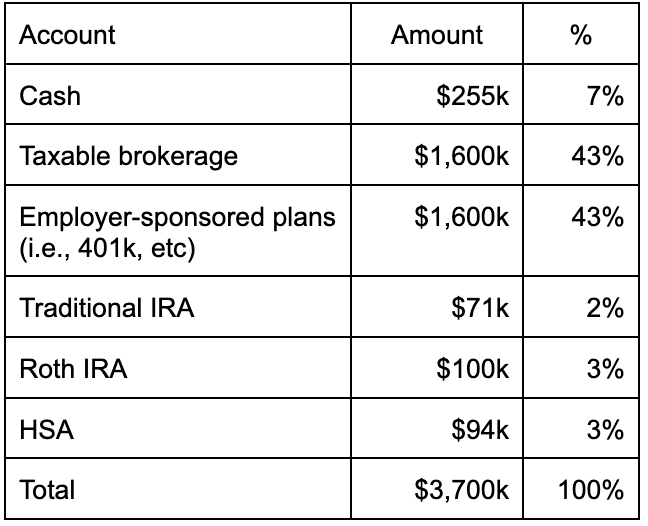
Just under half of my net worth is in a taxable brokerage account, and an equivalent amount is in tax-deferred retirement accounts (i.e., 401k, traditional IRA, etc.). A small portion is in tax-free accounts (i.e., Roth IRA, HSA, etc.).
I don’t own any real estate (including a primary residence) or businesses. I also don’t have any debt.
EARN
What is your job?
I am one level below a partner (owner) at a professional services firm.
What is your annual income?
My current base salary is $278k and there is the potential to earn annual bonuses based on performance.
I expect my income to drop significantly in the near future, as I am planning to retire or at least downshift in my career.
Tell us about your income performance over time. What was the starting salary of your first job, how did it grow from there (and what you did to make it grow), and where are you now?
In my first year hired directly out of college, my starting salary was $55k. I broke the $100k mark 6 years and 2 promotions later.
It took me another 6 years and 1 more promotion to get my salary past $200K. I am one of those endangered species that worked for the same company my entire career.
What tips do you have for others who want to grow their career-related income?
In the first ~15 years of my career, I rose through the ranks relatively quickly and opportunity felt abundant. Basically, I was really good at my job.
I was reliable, hardworking, dedicated, and solved problems. My execution was top-notch.
I developed great relationships with my team and clients. I understood the big picture, which allowed me to think ahead 2-3 steps, anticipating and pre-empting problems before they occur.
To some extent, I viewed my job as making my boss and my clients look good.
In the last ~5 years or so, my career trajectory slowed significantly. My ego toyed with the idea of chasing institutional anointment (i.e., making partner at my firm), but it became clear that I didn’t have a sponsor with the political capital to advocate for me in the places where it mattered.
In terms of career growth, this would have been the time to make a transition to chase better opportunities. On the other hand, this is also the period of time where my net worth doubled and then tripled.
Seeing my investments make more than I saved or even earned was exciting, but in my case there was certainly a negative correlation between net worth and ambition.
Retrospectively, this tells me that while I picked a career that (i) I’m good at, (ii) I can be paid for, and arguably (iii) is something the world needs, it’s not (iv) something I love, so I did not reach ikigai. Which is fine; I don’t think your profession needs to be your passion.
But now that I don’t see a clear path to further advancement and I no longer need to do this for the money, I find I don’t have much of a desire to do this at all. To extend career longevity, I’d want to find something more intrinsically motivating.
What’s your work-life balance look like?
During my accumulation phase, my career was definitely a priority. 50-60 hour work-weeks were not unusual.
A fair bit of my workload involved international projects, so late-night calls with global teams and international travel were also the norm. There was a period where I never took a vacation without my work laptop (although that was as much a lack of boundary-setting on my part as anything else).
Do you have any sources of income besides your career? If so, can you list them, give us a feel for how much you earn with each, and offer some insight into how you developed them?
No; I focused solely on my career for income generation.
SAVE
What is your annual spending?
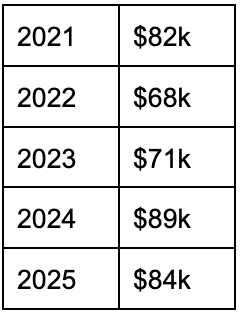
These amounts do not include taxes or the cost of employer-sponsored healthcare benefits, which will soon be relevant when I pull the plug on my career.
What are the main categories (expenses) this spending breaks into?
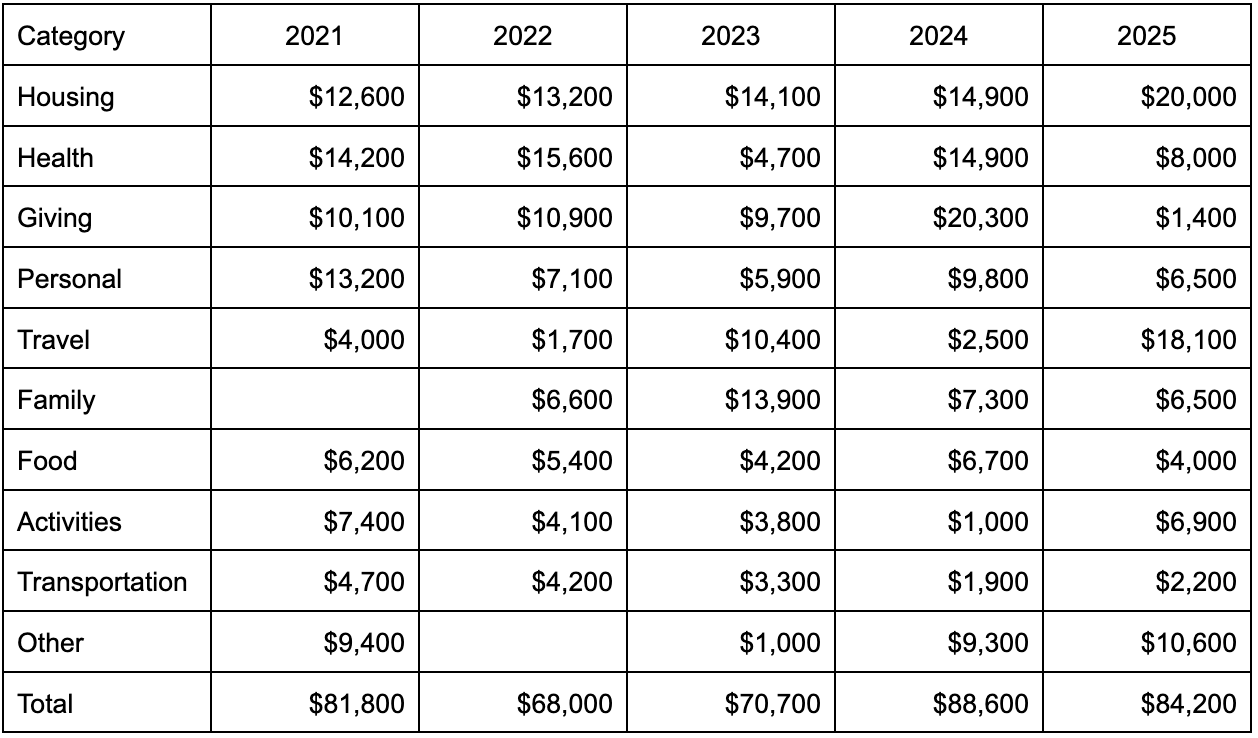
Do you have a budget? If so, how do you implement it?
It is probably more accurate to say that I track my spending. I have 10+ years’ worth of annual spreadsheets meticulously documenting each transaction down to the penny.
(Did I mention I’m an accountant? lol) At the beginning of the year, I draft a “budget,” but if my spending in one category starts to exceed expectations, I don’t necessarily have a strict limit. I tend to struggle more with hoarding tendencies than profligate spending.
What percentage of your gross income do you save and how has that changed over time?
I have historically saved roughly half of my post-tax income. In my head, ⅓ of my salary went to taxes, ⅓ of my salary went to savings, and ⅓ of my salary went to spending.
That’s not quite accurate but directionally correct.
Obviously, that savings rate developed over time. I was certainly not saving half of my $55k starting salary.
It took quite a few years to ramp up to that level, but most of every raise went to savings and a small part went to lifestyle inflation. I started contributing to my 401k immediately.
I don’t remember the exact amount or %, but I at least got the company match and set the percentage to automatically increase each year until I reached the 401k contribution limit. I also started building an emergency fund and contributing to a Roth IRA / traditional IRA* (*although I consider this a money mistake, which I describe below).
When I maxed out my 401k, I started funding a taxable brokerage account. I also had a high deductible health care plan from the start, and I’ve maxed out the HSA as far as I can remember.
At the height of my career, I was saving over $100k per year. Although, by the time I got to that point, my investment earnings were consistently outpacing my savings.
A 50% post-tax savings rate was aggressive enough to prevent me from spending thoughtlessly, but it left me enough discretionary income to live what I considered a comfortable lifestyle. According to the seminal Mr. Money Mustache article “The Shockingly Simple Math Behind Early Retirement,” a 50% savings rate (as a percentage of your take-home pay) will put you at financial independence in 17 years.
I would say the timeline has been pretty accurate in my case.
What’s your best tip for saving (accumulating) money?
Automate. Take the time to set up the infrastructure for success, and give yourself the gift of making one decision upfront instead of relying on willpower to make the right decision every time.
This reduces decision fatigue and allows you to focus your cognitive bandwidth on the strategic decisions (i.e., overall savings rate) instead of the minute-to-minute decisions (i.e., can I take that vacation). You won’t miss the money you never see.
What’s your best tip for spending less money?
Awareness. Most spending leaks happen in the dark, so shining a little light on your spending habits can go a long way.
I don’t recommend everyone be as anal diligent as I am at tracking, but taking the time to regularly review purchases gives you an opportunity to assess if the transaction was truly a valuable exchange or if there are any trends in your spending habits.
Another thing that has made a significant difference in my life is focusing on the “big rocks”. The top 3 categories of spending for the average American household are housing, transportation, and food.
In terms of housing, I reduced my costs through house hacking. In terms of transportation, I paid cash for both of the vehicles I have owned (both mid-range, one used / one new) and found a trusted mechanic to maintain them regularly.
In terms of food, I generally brown-bagged my lunch and cooked meals at home. By being intentional about my spending in the major areas, I gave myself the freedom to buy as many avocados and lattes as I wanted.
What is your favorite thing to spend money on/your secret splurge?
I have a rather specific set of activities that I enjoy, so they shall remain nameless for the sake of anonymity. I like Ramit Sethi’s philosophy on the subject of splurges, which is something along the lines of, “spend extravagantly on the things you love and cut costs ruthlessly on the things you don’t.”
I have long given myself permission to spend generously in my chosen area, and a few years ago, I went to an unlimited budget. If I wanted to engage in these activities, I did so without regard to cost.
More often, I found that time (and job obligations) was the limiting factor. Eliminating the sense of restriction around these activities as one of my “money dials” (as Ramit would say) and thoughtfully creating the structure to support spending extravagantly in these areas really does contribute to a sense of living a “rich life” (to borrow his words).
INVEST
What is your investment philosophy/plan?
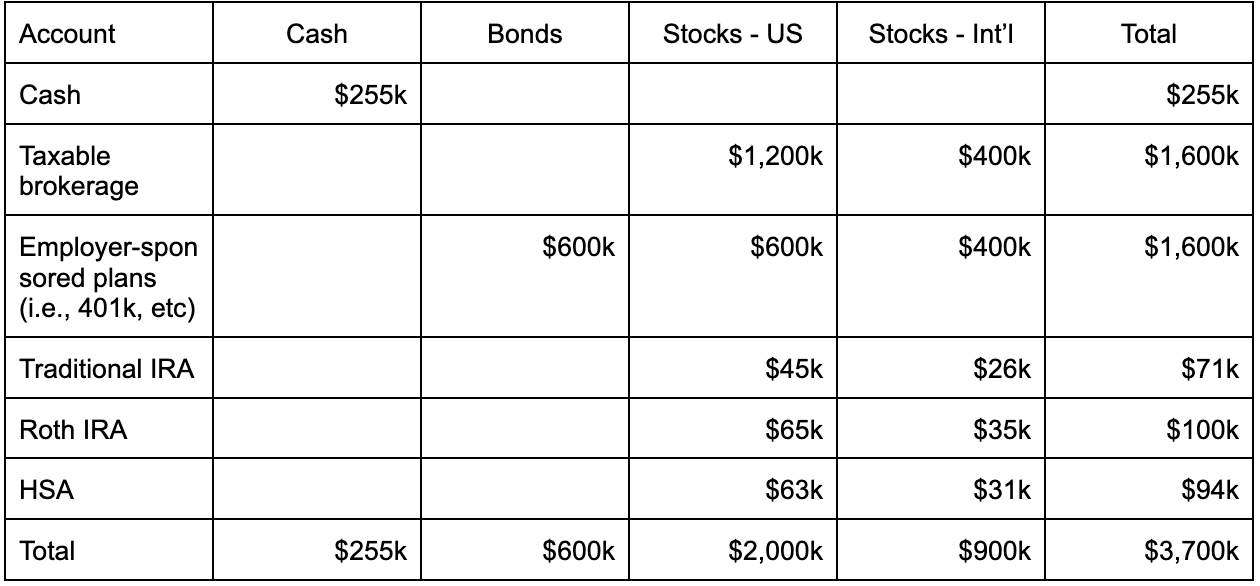
I generally follow the Boglehead philosophy of owning low-cost, diversified index funds. During my accumulation years, with the exception of my emergency fund, I was nearly 100% invested in stocks because stocks had the highest long-term return.
In my employer-sponsored tax-deferred accounts (i.e., 401k), I picked a low-cost global stock fund. In my taxable brokerage account, I owned VTSAX and VTIAX.
Since I was a high performer at work with every expectation of a stable income, I was confident that I could ride out any interim fluctuations in the market without needing to sell stocks at a loss.
Last year, as I cast my eye towards retirement, I shifted my position to ~80% stocks, 20% bonds/cash.
(These are approximate numbers, rounded, so the math doesn’t quite math.)
What has been your best investment?
My best investment has been in my financial education. My parents gave me many privileges and opportunities, including the foundations of personal finance (i.e., spend less than you earn), but they did not have a comprehensive financial framework.
What do you do with the money that you save (i.e., how to invest)? Should you save in your 401k or emergency fund (i.e., financial order of operations)?
How much is enough? Back in the day, you used to get hard copy magazine subscriptions as prizes and incentives.
When those came my way, I often chose a money magazine. I also found Mr. Money Mustache, the White Coat Investor, and other personal finance blogs fairly early on.
What has been your worst investment?
A few years ago, I experienced a significant health event that left me unable to work for an extended period of time. In a moment of weakness, I handed the taxable brokerage portion of my portfolio to a financial advisor.
They dumped my international stock (triggering a taxable event) and reinvested the proceeds in a hodge-podge “proprietary mix” of funds. When I regained control over my portfolio, I decided to unwind their actions (triggering another taxable event) and reallocated my portfolio.
The silver lining is that my basis in this portion of my portfolio is significantly higher, so my capital gains in the future will be lower when I sell these particular stocks.
What’s been your overall return?
I haven’t tracked this metric, but based on my investing philosophy, I expect my overall return has closely matched the global market.
How often do you monitor/review your portfolio?
I used to update the portfolio balance on my net worth tracker once a year, at the end of the year. Now that I’m closer to retirement, I update my portfolio quarterly.
I still track my spending monthly.
NET WORTH
How did you accumulate your net worth?
I accumulated my wealth the boring way – that is, by consistently investing over a long period of time. I had many benefits and privileges along the way, such as a high salary, minimal student loan debt, no significant breaks in my employment along the way, and no external obligations (i.e., caregiving).
I started early and my savings accelerated with my earnings; eventually, compound interest took over.
What would you say is your greatest strength in the ESI wealth-building model (Earn, Save or Invest) and why would you say it’s tops?
I don’t think I outperformed in any specific category, but I have been consistently strong in all three categories. In terms of Earn, I’ve been a relatively high income earner for most of my career.
In terms of Save, I maintained a ~50% save rate for (again) most of my career. In terms of Invest, I started investing in my 20s and caught the wave of the current bull market.
There are many who have created wealth by excelling in either Earning, Saving, or Investing, but the combination of having done consistently well enough in all three areas has served me well.
What road bumps did you face along the way to becoming a millionaire and how did you handle them?
I consider myself lucky that I didn’t face any significant road bumps on the way to becoming a millionaire.
What are you currently doing to maintain/grow your net worth?
Not much, currently. During my health crisis, I stopped contributing to my investment portfolio.
Since I didn’t know if or when my health would recover, I hoarded the income from disability payments in cash. Now that I am eying the finish line of my career, my cash and bond allocation are hindering my overall rate of return.
However, I view it as essential to managing post-retirement withdrawals. Still, barring a catastrophic sequence of returns, if my withdrawal rate stays fairly low (below 4%), my net worth is likely to continue to compound.
Do you have a target net worth you are trying to attain?
The old aphorism is that the target net worth is always twice as much as what you currently have. Starting out, $1m seemed like an unattainable goal.
When I reached $1m, $2m became the new goal. Even now, I can’t help but think $5m would be nice.
However, having emerged from a significant health event, I am now truly understanding that money is a tool, not a goal. Rich, Broke, or Dead is a helpful reminder that I am significantly more likely to be rich than broke, and at some point I will end up dead, so memento mori.
How old were you when you made your first million and have you had any significant behavior shifts since then?
It took me 10+ years in the workforce to obtain millionaire status in my mid-thirties. Due to the powerful combination of compound interest, a bull market, and some of my highest earning (and saving) years, my second $m came merely two years later (although I was quickly kicked out of the double double-comma club, thanks to the drawdown in 2022).
I made it to $3m three years later.
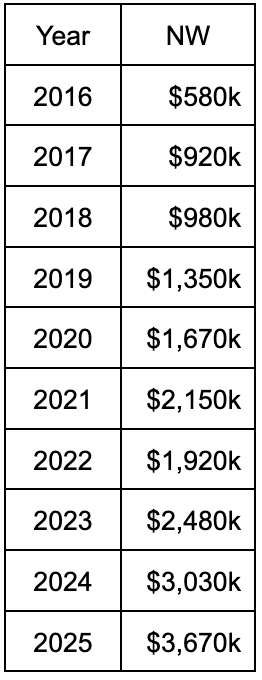
I don’t think I had any significant behavior shifts when I made my first million, because I recognized at the time that I was not yet financially independent. However, now that I do consider myself financially independent (and having faced my mortality), my biggest behavior shift has been tanking my career ambitions and looking forward to the next stage of my life where I can follow my passions.
What personal habits and/or traits have you developed that have made you successful at growing your net worth?
I think the biggest trait that made me successful at growing my net worth was my near-sociopathic ability to be unbothered by market fluctuations. Because of this, I was never tempted to time the market, get out when the market fell, change my asset allocation, or otherwise chase performance.
I simply and robotically dollar-cost averaged into the market every month and reaped the long-term rewards.
What money mistakes have you made along the way that others can learn from?
When I exceeded the income threshold to contribute to a Roth IRA, I started contributing to a traditional IRA. I made a few deductible (pre-tax) contributions to the traditional IRA for a few years before I learned about the backdoor Roth IRA.
In hindsight, I wish I converted the traditional IRA to a Roth IRA then and there, but I didn’t want to take the tax hit at the time. That mistake compounded a few years later, when the mega-backdoor Roth IRA option became available through my employer-sponsored 401k.
The balance in my traditional IRA had grown, and (my aversion to dealing with) the pro rata rule prevented me from participating in the mega-backdoor Roth IRA.
For a few years, I made nondeductible (after-tax) contributions to the traditional IRA, filing IRS form 8606. So the current balance in my traditional IRA consists of a mix of after-tax basis, pre-tax contributions, and earnings/growth.
During my low-income years, I plan to convert the traditional IRA to a Roth IRA at some point. When I do that, a small silver lining is that a portion of the converted amount will not be taxed again.
If I could go back, I would tell my younger self to start doing backdoor Roth IRAs immediately once I “graduated” from making direct contributions to Roth IRAs, so that I could keep a zero balance in the traditional IRA.
What advice do you have for ESI Money readers on how to become wealthy?
For most of us, becoming wealthy requires intention. Money is an emotional subject, but the mathematical underpinnings of personal finance are fairly straightforward.
Take the time to become educated, and be intentional about your life and finances. Your future self will thank you.
I think it was Dave Ramsey who said something to the effect of, “Live like no one else now, so that you can live like no one else later.”
FUTURE
What are your plans for the future regarding lifestyle?
I am planning to at least downshift from my current role in the near future, and I have no plans to seek future employment.
I am open to interesting opportunities if they come my way, but I plan to relish my new time freedom.
What are your retirement plans?
Financially, my anticipated annual budget includes $90k of living expenses (based on historical spending, see above) plus another estimated $40k for taxes and healthcare. $130k is 3.5% of my current portfolio, which seems to be a reasonable initial withdrawal rate.
The 4% rule is most commonly cited in the personal finance community, but given my portfolio may have to support me, if I’m lucky, for longer than the standard 30-year retirement planning timeframe, conservatism seems prudent. BigERN of Early Retirement Now and his safe withdrawal rate series were helpful resources for thinking through this.
Non-financially, I plan to spend my time focused on health/fitness as well as relationships with family and friends.
Are there any issues in retirement that concern you? If so, how are you planning to address them?
Healthcare, not surprisingly, is an issue that concerns me. With my medical situation, I am a high user of the healthcare system and pretty much uninsurable from an individual perspective.
Without an employer-sponsored plan, I need to be able to purchase insurance coverage on the open market (i.e., ACA exchange).
My starting retirement budget assumes that I will pay full unsubsidized premiums for health insurance and hit the out-of-pocket maximum. Under these assumptions, my initial withdrawal rate from my investment portfolio is 3.5%.
That said, under the current ACA regime, a 60-year-old can (for the most part) expect to pay roughly twice the amount in healthcare insurance premiums as a 40-year-old. As such, I expect my withdrawal rate will rise along with healthcare costs as the years pass.
Even so, I have a few options to handle this. First, there is plenty of discretionary spending in my budget that can be eliminated if needed.
Additionally, I am considering managing my income strategically to be eligible for subsidies in alternating years. Overall, I expect my finances and my lifestyle to have enough buffer to absorb the rising costs until I am eligible for Medicare at age 65.
Still, who knows how the regulatory landscape will evolve?
If the ACA were to become untenable, then I’d have to make some tough decisions. Would I go back to work for the healthcare benefits?
Would I attempt medical tourism or potentially emigrate to another country that provides universal healthcare? Let’s hope it doesn’t come to that.
MISCELLANEOUS
How did you learn about finances and at what age did it “click”?
My education in finances was mostly self-directed in my twenties.
Who inspired you to excel in life? Who are your heroes?
In general, I really admire those who live a life true to themselves. When I was younger, I was rather preoccupied with “doing the right thing.”
In this context, that meant getting good grades, going to a good college, getting a good job, doing well at said job, etc. I think I struggled with a scarcity mindset and sought external validation through achievement.
It wasn’t until my life was literally on the line that I realized that I didn’t want to play that game anymore. Thankfully, Past Me gave Future Me the gift of financial independence, and I am so grateful that I now have the privilege to explore a different path.
Do you have any favorite money books you like/recommend? If so, can you share with us your top three and why you like them?
There are so many good resources on this topic, many of which have already been recommended here frequently.
I am not covering any new ground here, but a few books that got me started on my financial journey are:
- The Millionaire Next Door, by Thomas Stanley and William Danko
- Your Money or Your Life, by Vicki Robin and Joe Dominguez
- The Simple Path to Wealth, by JL Collins
- I Will Teach You to be Rich, by Ramit Sethi
- Smart Women Finish Rich, by David Bach
The library is a valuable resource!
Do you give to charity? Why or why not? If you do, what percent of time/money do you give?
I give money consistently to charity, but I would like to be more consistent about giving at a higher rate. The 10% tithe has been an aspiration of mine, albeit one that I’ve rarely met.
I’ll have to consider how to evaluate my giving (in both time and money) once I cease income-generating activities. Perhaps I’ll try to give away 10% of my annual spending, but I haven’t committed to a plan.
This is one area where I struggle, because I feel like I “should” do more, given how fortunate I have been.
Do you plan to leave an inheritance for your heirs (how do you plan to distribute your wealth at your death)? What are your reasons behind this plan?
While I’m still living, I plan to give to the next generation in my family (nieces and nephews) by contributing to their education expenses, taking them on vacation, and celebrating milestone events (i.e., gap year, wedding, house purchase, etc.), as applicable.
I also hope to give the next generation a head start on a financial education. When I die, my trust currently divides my assets between my siblings and their children.
This is very much evolving as the children are still young, and I hope to have many more years left. That said, I know how quickly circumstances can change, so I’ve set up an estate plan just in case.
I know it won’t be perfect, but hopefully it will be mostly good enough.

Well done and thank you for sharing. Addressing the healthcare gap between now and 65 remains one of the challenges for most individuals. While the ACA is an option, I know others who have successfully used Health Sharing Ministries. Depending on your faith, this could be another option.