
 Today I have an update for you from a previous millionaire interview.
I’m letting three years pass from the initial interviews to the updates, so if you’ve been interviewed, I’ll be in touch. 
This update was submitted in April.
As usual, my questions are in bold italics and their responses follow…
OVERVIEW
How old are you (and spouse, how long married)?
I am 59 and my husband is 62.
We’ve been married for 33 years.
Do you have kids?
No children.
What area of the country do you live in (and urban or rural)?
We live in the mid-Atlantic area of the US in an urban neighborhood.
What was your original Millionaire Interview on ESI Money?
I was Millionaire Interview 337 published in late 2022.
Anything else we should know about you?
We are five years into retirement and enjoying every minute.
Initially, we were concerned about boredom and getting in each other’s way but no problems so far.
We’ve kept busy with a home renovation, hobbies, consulting, family, friends and travel.
NET WORTH
What is your current net worth and how is that different from your original interview?
Our current net worth is ~$12 million vs. ~$10 million in 2022.
What happened along the way to make changes (detail good and bad experiences)?
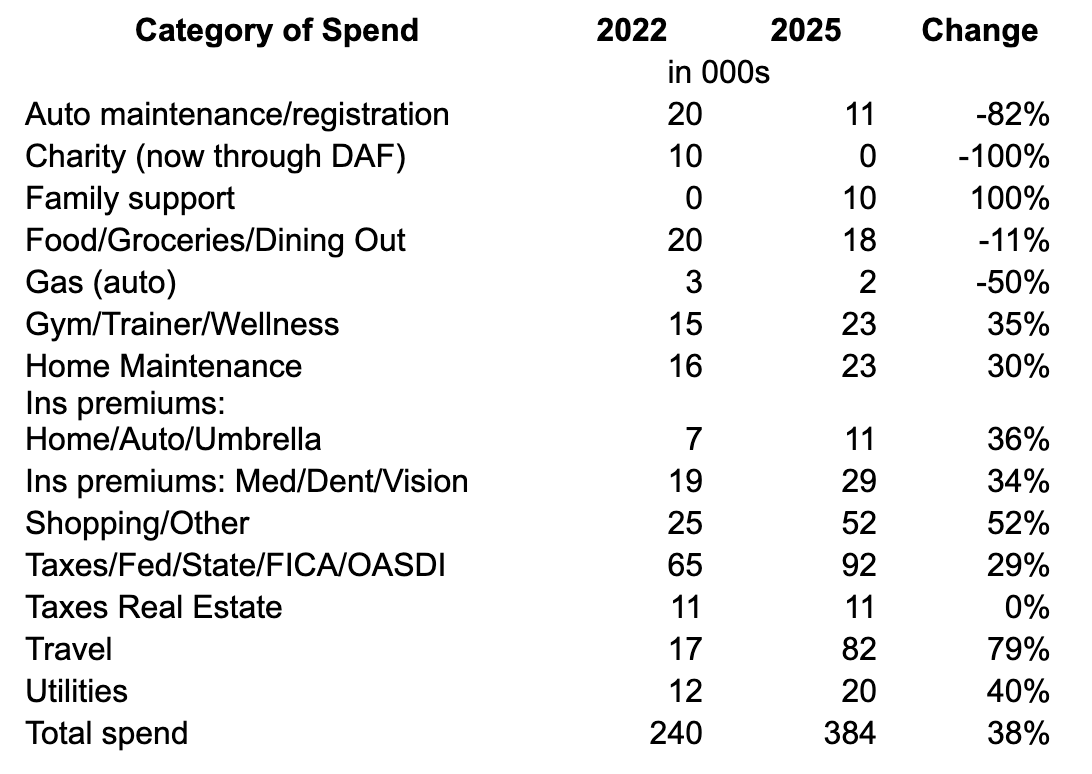
2022 was a tough year in the markets and, combined with several substantial withdrawals, it made for a stomach-churning way to start retirement. The withdrawals included: 1) deferred compensation draw down.
In 2022, it comprised ~10% of our net worth and is now depleted; 2) spent ~5% of our net worth on home renovations in 2023; and 3) established a Donor Advised Fund in 2025. We stuck with our financial plan and despite a sizeable decline, our net worth has since rebounded, and the composition has changed.
Overall, we’re satisfied with the growth and health of our net worth. As I explain later, our focus will now shift to proactively managing our large tax-deferred accounts, creating greater funding flexibility in future years, and (slightly) reducing our future tax bills.
Net Worth Mix:
What are you currently doing to maintain/grow your net worth?
We work with our Financial Advisor to adjust allocations and tax harvest as appropriate. The combination of deferred compensation and part-time consulting income has reduced (and some eliminated) the need to draw on the portfolio.
In terms of savings, we continue to make health savings account contributions. Since I have been earning W2 income from consulting over the past few years, we contribute the maximum to each of our IRAs.
EARN
What’s your job?
I am retired but consulting.
My husband is fully retired.
What is your annual income?
Roughly $420,000 annually. I’ve been drawing on ~$200,000 in deferred income annually since 2022.
In addition, my part-time consulting generates ~$120,000 annually.
Our taxable portfolio generates ~$100,000 annually, most of which is reinvested.
How has this changed since your last interview (and give background on why it has changed)?
The major change was the addition of my part-time consulting income. The opportunity to earn some extra income and defray some expenses (e.g., home renovation) was too tempting.
Most engagements last 3 – 4 months and I limit my time to less than 20 hours a week. I’m fortunate that I can cherry pick the engagements that I think are interesting.
Have you added, grown or lost any additional sources of income besides your career?
As referenced above, part time consulting generates ~ $120,000 in W2 income annually.
SAVE
What is your annual spending and how has it changed since your last interview?
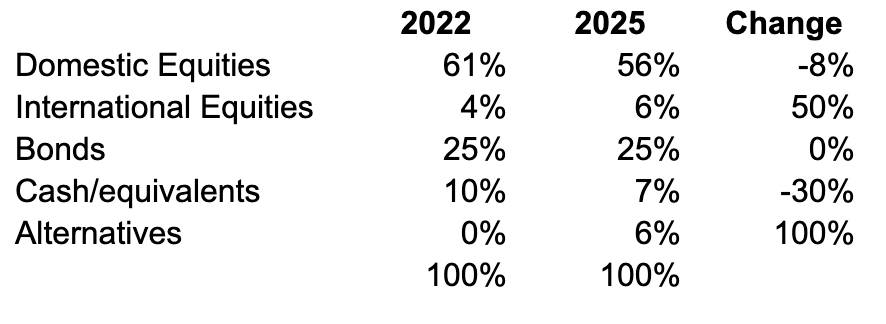
Our annual spending is $348,000.
That figure grew substantially higher over the past two years (up 38% between 2025 and 2022).
What happened along the way to make these changes (detail both good and bad experiences)?
Insurance (health, home, auto, umbrella) and taxes (fed, state, payroll) drove some of the spending increase. The rest is driven by deliberate choices to invest more time, energy and money in travel, health/wellness and family support.
We now make our charitable contributions through our Donor Advised Fund. While we’re extremely happy with the home renovations (made in 2023), writing those large checks was difficult given the previous ~18 months of dismal investment returns.
At the same, we were drawing down my deferred compensation. For a time, it seemed like the portfolio was on a permanent downward trajectory.
The consulting income helped offset some of that anxiety.
Over the past few years, we’ve provided financial support for family members. My husband’s parents are divorced.
One of them depends solely on social security for income. We’ve taken over payment for their insurance (including long term care) and real estate tax payments as well other needs (e.g., car repairs, registration, etc.).
We’ve set aside additional funds to support their needs as they arise. We also have a nephew who has substance abuse issues, and we’ve provided financial support for his in-patient and out-patient treatment.
We feel blessed to be able to support them.
INVEST
What are your current investments and how have they changed over the years?
What happened along the way to make these changes (detail both good and bad experiences)?
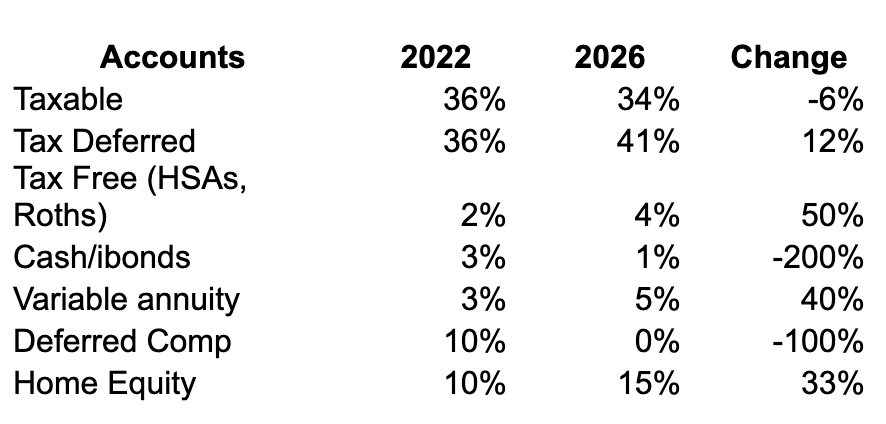
The portfolio has shifted in several ways over the past five years:
- continued to grow our tax-deferred accounts which comprise the largest portion of our portfolio
- depleted my deferred compensation account
- changed financial advisors in 2023 (see more below) and made some portfolio adjustments
- established Roth accounts
- established a Donor Advised Fund
Key changes over the past few years…
- Changed financial advisors (FAs): While we had solid FAs prior to 2023, they made some changes to their model that weren’t aligned with our investment approach. We researched and interviewed numerous FAs and found an independent Registered Investment Advisor that fit our needs. In making the move, we made several changes to strengthen the portfolio, detailed below.
- Draw down of deferred compensation: 2026 will be the final year of my deferred compensation payout. What worked well: Tax savings.
- We reduced our marginal Federal tax rate from 39.6% to 24% and reduced our state tax rate by at least 50 bps per year (our state gradually reduced the flat tax rate over time). What didn’t work well: Overly conservative investments.
- When the bear market hit in 2022/2023, I became overly conservative with the investment choices. In hindsight, I should have been somewhat more aggressive to compensate for inflation.
- Performed a 1035 exchange/ variable annuity: We made a 1035 exchange with our variable annuity to a very low-cost option. We’re happier with the new annuity in terms of performance and cost. Lesson learned and not to be repeated: annuities are not a good investment for us and my biggest investment regret.
- Exited individual stocks during ‘22/23 downturn: A hangover from our portfolio strategy circa 2012, we held a broad mix of individual stocks. While the approached worked at the time, we took advantage of the ‘22/23 downturn to shift out of those stocks and into EFTs.
- Added gold into the mix: Prior to 2022, we did not hold any gold in our portfolio. We added a gold EFT, and it has performed well to date.
- Experimenting with private credit (PC): We waded into the PC with a very small (<2%) investment in a company with a well-established track record. It took us a while to get comfortable making this investment. The objective is to learn about dividend performance, redemptions, overall performance, etc. It’s still early days but the dividend returns so far are impressive.
- Established Roth accounts: Our new FAs were very insistent that we “start the clock ticking” and create Roth accounts. We realized that my husband’s 401k had a chunk of post-tax contributions (from overzealous contributions during the 2000 – 2002 market downturn). He was able to fund a sizeable Roth account. On the other hand, I had no such luck and opening a Roth with a minimal conversion amount.
MISCELLANEOUS
What other financial challenges have your faced since your last interview?
No challenges however transitioning out of our 30+ year careers and steady paychecks was unnerving at times. We were well prepared financially but emotionally and mentally, it was scary.
That feeling playing into my decision to take on part-time consulting work. I felt that I should take advantage while I still have marketable skills.
The past few years have made us (me in particular) more confident that we can sustain our lifestyle without the need to work for income.
Overall, what’s better and worse since your last interview?
I think we’re in a stronger position now than in 2022. Despite depleting my pool of deferred compensation and making withdrawals to fund our home renovation, the portfolio has grown.
In addition, the mix of investments in our taxable accounts have positioned us well as we will start drawing on the portfolio to fund living expenses in 2027.
What are your plans for the future?
In terms of finances, we are focused on the following areas:
- Monitoring the potential impact of sequence of returns risk: 2027 will be the first year we’ll be solely dependent on our portfolio to fund our spending needs. We’re still getting comfortable with the idea (or at least I am).
- Despite accumulating a large portfolio, I am nervous about an extended market downturn and the effects of on-going elevated inflation. This is a major focus of our FA discussions. Of course, we can always adjust our annual spend accordingly.
- Proactively addressing the tax implications of our large tax-deferred accounts: We are hyper-aware of the expected tax bomb from the tax deferred accounts.
- We have done a significant amount of pre-planning with our CPA and FA to mitigate the expected tax bills, potential impacts on our estate planning, etc. There are a couple of steps to address the issue: a) Roth conversions.
- Between 2027 and 2033, when my husband begins social security, we will make Roth conversions up to the 12% tax bracket. This will likely be ~$100,000 a year. The objective is to give us future funding flexibility. Bulking up our tax-free accounts will allow us to draw funds from a mix of tax-free, taxable and tax-deferred accounts as needed and well as take the edge off the tax bomb; and b) Plan for Qualified Charitable Distributions (QCD).
- Our estate plan directs a portion of our portfolio to specific charities when we have both passed. Rather than wait until that time, we plan to make QCDs once my husband is eligible (age 70 ½) and adjust our estate plan accordingly. We prefer to put the money to good use now rather than once we are gone.
- Evaluating private credit opportunity: We opted for a very small (<2%) investment in private credit with a well-established company. This is a trial to see how it works, performance, redemptions, etc. We’ve been in the investment for a year, so still early days and we’re in no rush to investment more at this point.
- Learning about Medicare. We are blessed with retiree health care (medical, vision and dental) through my husband’s former company. Our premiums are not subsidized, and the premium increases have been 10%+ annually over the past several years. Ouch! While it’s tough to wrap my head around ~$30k health insurance premiums, the plans are high quality and include our current doctors and, when needed, our chosen specialists. We’re just starting to educate ourselves about Medicare as my husband will be eligible in 2028. I can already tell it will be a mind-numbing exercise.
- Preparing for continuing care (CC) /long-term care (LTC): while not a significant focus now, we will begin exploring CC options should the need arise. My parents were very proactive in moving to a wonderful CC facility and I learned a great deal from observing their experience. There are a growing number of CC facilities in our community, and we’ll have the opportunity to observe how they perform in the coming years. In terms of LTC, we are self-insuring.
- On-going estate planning: as we do not have children, any residual assets will be divided equally among our 8 nieces and nephews. We will likely utilize QCDs during our lifetime to provide for our favorite charities. Depending on how our portfolio performs over the next ~5 years, we may start distributing a portion of their inheritance while we’re alive. Their parents are aware that their children will inherit but do not know the specifics. Most of them have built productive lives with loving and growing families. One of them, currently age 36, has experienced substance abuse issues for 10+ years and has a track record of poor life choices. Our concern is that this individual won’t be able to responsibly handle inheriting any sum of money (whether we’re alive or not). We are wrestling with if/how to provide for them and exploring options (e.g., establish a trust for them, reduce/eliminate their inheritance, other?)
Given that you have a bit more wisdom and experience, what advice do you have these days for ESI Money readers?
A couple of thoughts I’ll share about our experience:
Engaging Financial Advisors (FA)
The choice of retaining an FA is right for us. We pay our FA on an AUM (assets under management) basis at a very low rate.
I manage all the finances in our household (budgeting, investments, etc.) by choice. My husband has no interest in any of it.
I ensure that he is fully educated on our finances and involved in all major decisions but it’s simply not his cup of tea. While I enjoy managing our finances, I don’t want the stress of managing the portfolio on my own.
And, if something should happen to either one of us, we know we have a trusted and knowledgeable FA in our corner (along with a CPA and Estate Lawyer). We are fortunate we’ve had reputable, honest FAs along the way. In our view, the fees are worth the peace of mind.
Shifting from savings/investing to spending.
This transition has been difficult for me.
It’s a good problem to have but I am still trying to find my comfort zone. In addition, there’s more complexity at this stage in our lives.
For decades, we had a singular goal to accumulate a sizeable nest egg. Now, we have multiple goals: enjoy life and spend accordingly (but not too much); manage tax brackets and implications (e.g., take advantage of the next ~10 years for Roth conversions, address IRMAA impacts in a few years, etc.), and ensure inflation doesn’t decimate the portfolio over the long run.
Health really is wealth.
We know there are a limited number of healthy years left in our lives.
Our focus is on extending those years as far into the future as possible. Our investments in daily exercise, trainers, a physical therapist (a must have in my view), a masseuse, high quality food, etc. are purposeful.
Over the past few years, we’ve each had a short-term health issue, nothing life-altering or threatening. Having a team of people who know us and were there to help us get back on our feet made a significant difference physically and mentally.
Donor Advised Fund.
We’ve used the DAF to increase our gifting to our favorite charities.
Most are based in our local communities, and it’s been a joy to support them and see the impact they’re making.

Leave a Reply