
 Here’s our latest interview with a millionaire as we seek to learn from those who have grown their wealth to high heights.
If you’d like to be considered for an interview, drop me a note and we can chat about specifics.
This interview took place in April.
My questions are in bold italics and their responses follow in black.
Let’s get started…
OVERVIEW
How old are you (and spouse if applicable, plus how long you’ve been married)?
We are 63 and 64.
We’ve been married over 35 years.
Do you have kids/family (if so, how old are they)?
We have three successful young adults mid-20’s to mid-30’s.
We have three living parents in their upper 80’s.
What area of the country do you live in (and urban or rural)?
A university town in the south.
What is your current net worth?
$8.9 million (February 2026).
What are the main assets that make up your net worth (stocks, real estate, business, home, retirement accounts, etc.) and any debt that offsets part of these?
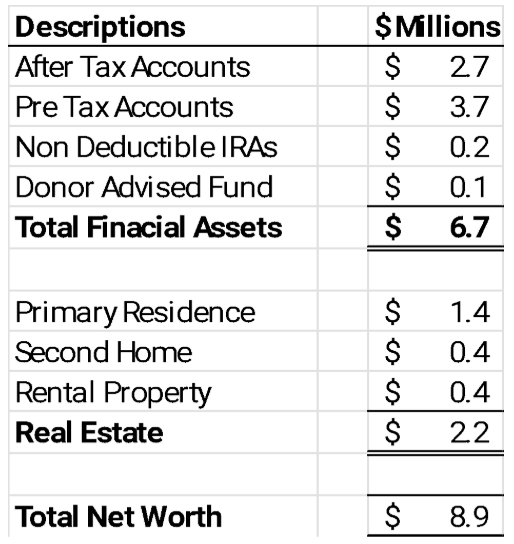
We have been debt free since late 2000’s.
- Individual Stocks $350k
- Cash and Treasury Notes and Bills $300k
- The Remainder of holdings are primarily Index Funds (VTI largest single holding $2.7M and VOO $300k) and the balance in bond funds, many laddered with maturities over the next 5 years (thank Christine Benz for an article on this topic)
- HSA $50k
- ROTH Accounts $30k
EARN
What is your job?
We began our careers in “Big 8” public accounting firms and later both joined clients and spent most of our careers in Operational Finance. I retired as an Operations Executive 6 years ago within a business unit of a multi-billion public company.
My wife worked for smaller public and private companies as the top Financial Executive/Manager and finished the last fifteen years of her career working for non-profits and retired 3 years ago.
What is your annual income?
2025 – $95,000 (Deferred Compensation, Dividends, Interest Income)
Tell us about your income performance over time. What was the starting salary of your first job, how did it grow from there (and what you did to make it grow), and where are you now?
My first job in public accounting for a “Big 8” firm was $24,000 plus a small bonus. My wife had similar compensation.
We each got sizeable bumps when we left public. We both worked full-time with similar income until slightly after our second child was born.
After that I became the primary earner and she later picked up a part-time hybrid work from home arrangement. I had a great mentor that was a very tough boss, he believed strongly in moving folks around to gain different experiences and prepare for potential promotions.
This bore fruit as I found myself the youngest director-level person in our organization. After a dozen years, in the late 90’s the conservative management resisted moving to modern financial reporting software.
My staff was cut in half, and the foreign home office cherry-picked the fun parts of my job to justify their corporate overhead. I recalibrated and we relocated to join a small private company with stock options to make millions during the Biotech/Telecom/Dot Com boom.
This was the first VP title role, albeit with a very small (75 people) organization and it was a good opportunity to “do it all” in Finance/IT/HR. After several early rounds of private equity, it was clear we missed our window to ring the register for a big payday.
An offer by a large competitor was dismissed by the founder and angel/friend investors and a liquidity event never happened.
One of my previous peers called me when his recent public company spin-off was reorganizing and needed an operations VP of Finance. I landed the role, my compensation almost doubled and I returned to the corporate environment where I thrived.
The chart below provides annual W-2 Earnings fluctuations over my 35 year career.
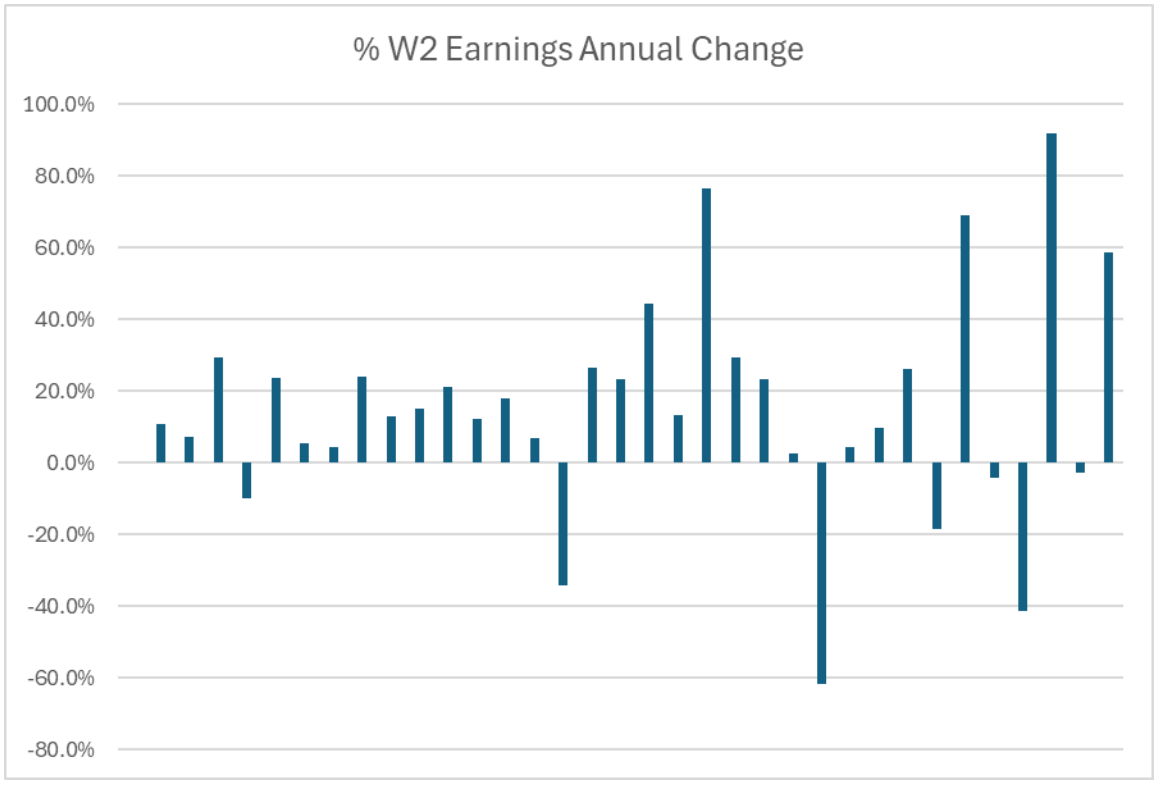
Medicare Wages in first 17 years totaled $1.1 million.
Medicare Wages in last 18 years totaled $7.0 million.
What tips do you have for others who want to grow their career-related income?
My motivation to provide value and increase/improve my skill set and experience was a major benefit in raising the ceiling of potential roles in current and future organizations. Early on, I made it a habit to walk down to my manager’s office when I finished my monthly responsibilities and ask, “What are you working on, can you show me and I’ll take it off your plate?”
Professional certifications carried a lot of weight, and the CPA certificate went a long way in opening doors at higher levels in organizations.
Maintain relationships with coworkers, vendors, and mentors. I worked at 4 organizations, the first was landed through campus interviews, but ultimately my role in campus accounting and business organizations created the relationships with recruiters that placed me in their pre-ID programs, I picked up three top tier public and industry job offers with just over a “B” grade point.
These firms spent time getting to know me and appreciated my other skill sets beyond a transcript giving them insight on my “fit” in their organization. Ultimately, the job that really accelerated my earnings growth and powered my early retirement came through a previous peer coworker.
We had provided references for each other on other stops through our careers and ended up spending decades working within the same organizations. Additionally, my W2 career was 35 years total and 30 of those years was with two companies.
My point here is if you find a good organization, with good mentorship, nice margins, and an upward path, build your intangible value and reap the rewards through increased responsibilities and long-term compensation vesting.
What’s your work-life balance look like?
My first job in Public Accounting had no balance, that was the primary reason for leaving. I continued to make work a priority, within reason (rarely if ever having to work weekends) but really didn’t find a great equilibrium until the mid-2000’s.
My peers and superiors would routinely leave mid-afternoon to make ball games, or other functions with their kids without a second thought. I was always one to get my work done and once I embraced the family priorities, I never looked back.
We spent a lot of time at baseball, volleyball, soccer, piano recitals, and school functions. We built solid friendships with fellow parents that continue to stand the test of time.
Travel was pushed to Monday-Friday with weekends free. International trips sometimes took weekends, but I learned to do extra stuff with family when returning home.
In hindsight, I remember my bosses all taking spring break off and traveling with their families. It was kind of stupid for me to cover the office while my wife and young kids were day tripping with friends and making the most of the time off.
Thankfully, I woke up and changed my priorities.
Do you have any sources of income besides your career? If so, can you list them, give us a feel for how much you earn with each, and offer some insight into how you developed them?
We do have a debt-free rental property that does a little better than break even and the value has appreciated significantly. We enjoyed the kids and their roommates using it while in school and benefited from savings on their college expenses.
However, landlord hassles and seeing our investments perform so well in the market compounded by efforts to simplify life and maximize flexibility will likely mean the property will be put on the market. We bought it about 15 years ago and estimate we will double the investment after selling expenses.
Not the best return, but it did serve to diversify our portfolio with real estate.
SAVE
What is your annual spending?
- $ 78k New Car
- $ 10k Special Gifts
- $135k “Normal Spending”
- $223k Total Spend 2025
What are the main categories (expenses) this spending breaks into?
Our 5-year spending history by category is presented in the table below:
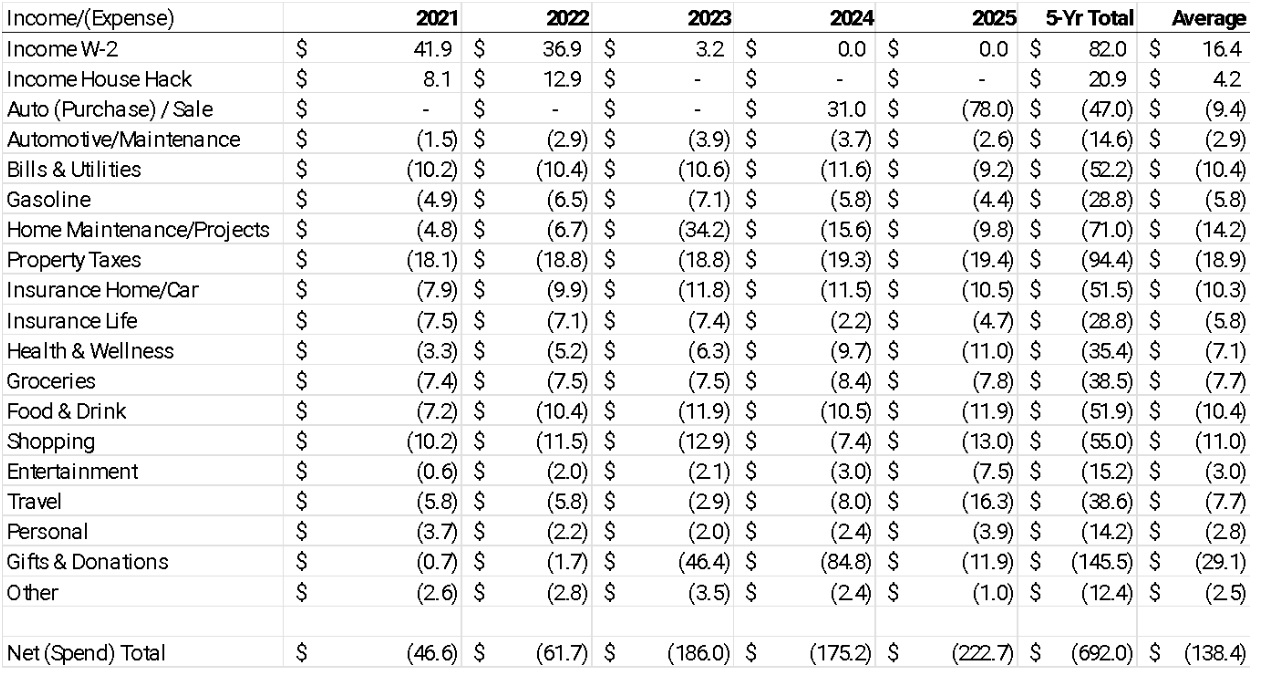
Note: Spending (000’s) above does not include any rental property costs/income. Both homes are included.
Federal Taxes are excluded; most relate to Deferred Compensation payouts and are basically conversion of Pre-tax to After Tax funds and the timing confuses the trends. In 2024 our effective tax rate was 13.3% and we fell in the 22% bracket.
We have been making a conscious effort to travel more during our Go-Go years and this is reflected in Travel/Entertainment/Food and Drink.
Note that Life insurance dropped significantly when we re-certified into a healthier premium class (2024 included some credit adjustments). I’m not sure we will keep life insurance much longer but have had a hard time cutting it off.
Do you have a budget? If so, how do you implement it?
We track spending closely and it was a quarterly exercise, but now I just try to update it 2-3 times a year and really scrub through it at the end of the year. If there are any major anomalies they are researched and discussed.
Our year end discussion is focused half on the past year, and half on the next year’s general goals, (Travel/Home Improvement/Car Purchase/Retirement Splurge plan).
For readers that are mid-career and considering early retirement, really knowing your spending and considering how it will change is key to building confidence in assessing when you have enough, and how much conservative buffer you have accumulated. If you truly value your freedom, eventually you have to walk out the door. Resist the “one more year” mentality and start living the retirement you planned.
Time and Go-Go years are unrenewable/limited resources.
What percentage of your gross income do you save and how has that changed over time?
During my last few years working we saved >80% of my compensation mostly as deferred income. It was helpful for early retirement cash flow planning to pay out at lower tax rates post-retirement and bridge the years before Social Security.
This approach allowed our portfolio to remain invested in equities.
During our working years, we always contributed to 401k/403b and were able to limit out the last 20 years. We always treated the family to something with bonus money but usually 80% of bonus money went to debt reduction on the mortgage or increasing after tax investments which proved very helpful to fund cash purchases of vehicles and real estate and pay for college tuition.
Each of the kids had a car to drive (no new cars) and graduated debt-free.
What’s your best tip for saving (accumulating) money?
Live below your means. Early in your career there is not much buffer to work with, but as your top line grows, you have two choices.
Increase lifestyle or invest for your future. I know a large reason for our financial success was a healthy top line.
But you could look in my garage and see that we lived a modest life. Mom always had a reliable family car (purchased new), and I drove an A-B machine. We took vacations, enjoyed meals out, and the kids played school and club sports, and took music lessons.
As adults my kids say they enjoyed their childhood and our family lifestyle.
What’s your best tip for spending less money?
We are very much comparison shoppers on most everything. We check Car/Home Insurance every few years and don’t hesitate to move it if savings are substantial.
The insurance pricing models are geared to landing new customers and recovering margin by increasing premiums on loyal customers. We try not to do too much business with friends as this can strain relationships and you never really know if you are getting a good deal with respect to market rates.
Also, cash is king. If you have cash you can take advantage of opportunities when they appear.
Paying cash for a car and selling your old car to a private party will add $1000’s to your bank account. In the 90’s we sold a suburban for $2500 more than the dealer was offering on the trade.
We never traded a car after that, and the internet has made it much easier to find buyers. We have enjoyed nice vehicles but held them for 10 years.
If you have problems with “shiny object syndrome” the sooner you learn to want what you have the better.
In general, when we make any purchase, we try to buy quality items that are usually more reliable and ultimately a lower total cost of ownership. Many items even bring value when we let go of them.
Embrace contentment.
What is your favorite thing to spend money on/your secret splurge?
First would be grandchildren, but we did splurge on a nice home. I’ll admit the Sunday night family dinners we have every few weeks remind me of the closing scenes from Blue Bloods.
As retirees, we spend a lot of time in and around our home and there are zero regrets on spending a little extra for the benefit now and in the future. We designed it so we could age in place but may consider giving/selling it to one of the kids families when it is just too much for us to enjoy.
Our home also serves as the funding of last resort for any significant long-term care (LTC) issues.
INVEST
What is your investment philosophy/plan?
We are believers in having an investment policy and implementing the tenets of the policy. Our investing philosophy today is much more disciplined and consistent than in years past.
We own low-cost index funds. This has rewarded us in the last several years but the exposure to equities has brought short and longer scares in 2020 (Covid), 2022, and early 2025 (tariffs) along with the tremendous growth years.
We loosely utilize a bucket strategy. Affordable Care Act (ACA) credits have made healthcare a much lower expense than we had planned.
Potentially, even after the recent law changes, we may qualify for a fully funded bronze plan provided our income remains below 4X poverty level.
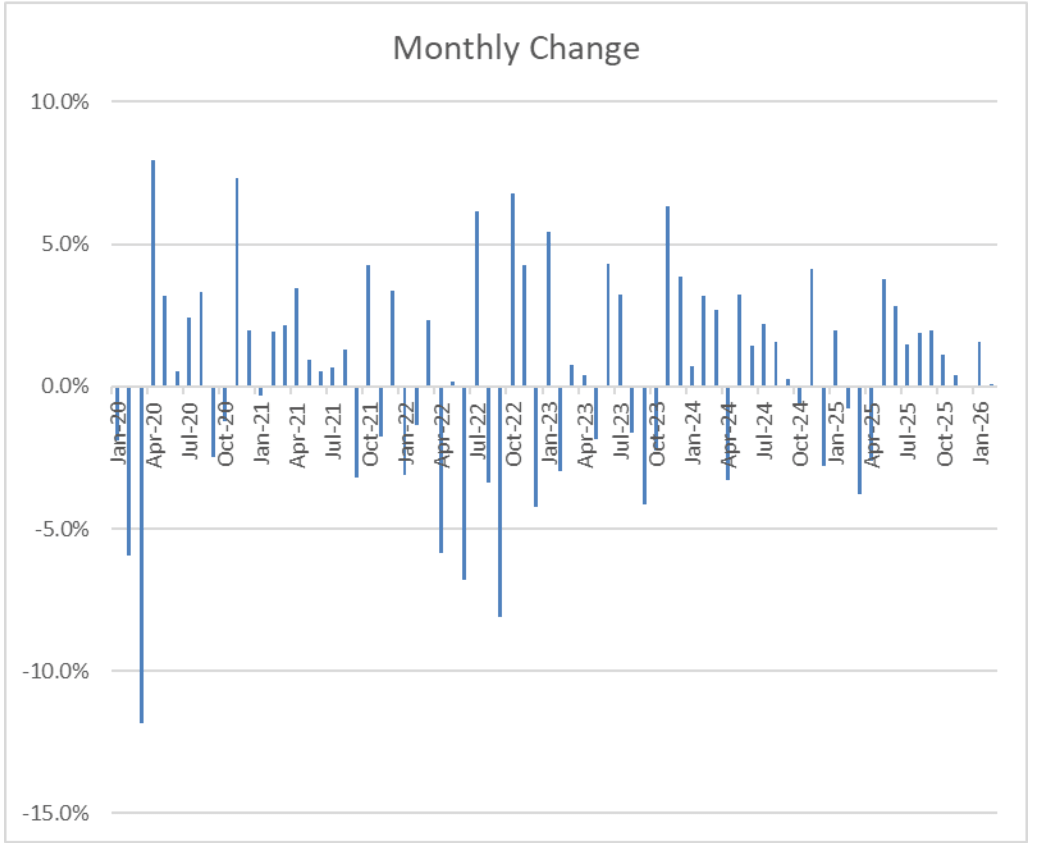
To drive home a key point of the investment policy mentioned above, you have to stomach the downs as well as the ups. Our monthly balance moves of financial assets are shown below since the beginning of 2020.
It takes discipline and consistency to dismiss the headlines sky is falling media and know the long-term strategy includes volatility on the short term. Placing near-term funds for spending in appropriate risk buckets helps to prevent these disruptions from permanently impacting your long-term retirement finances.
The chart below includes our monthly combined financial accounts fluctuations since the beginning of 2020.
What has been your best investment?
AOL (early pre-splits investor) and Facebook (IPO shares) are the highest returns, but by far, VTI/VTSAX has been our best investment from a gross return and peace of mind. The decision to pay off our mortgage in 9 years in the mid-2000’s and being debt free since is also one of our best investment decisions with guaranteed return of 7%.
The free cash that debt freedom provided funded much of our kids college education.
What has been your worst investment?
Company stock. More specifically, my behavior with company stock.
I should have liquidated it at vesting and diversified the proceeds. I think my bias towards my company and the industry led me to make poor decisions in capturing value.
My company stock made us millionaires in our 40’s and funded a second home, but the options/shares that were not sold expired worthless (options) or generated significant capital losses (restricted shares) after significant taxes were paid on vesting values.
What’s been your overall return?
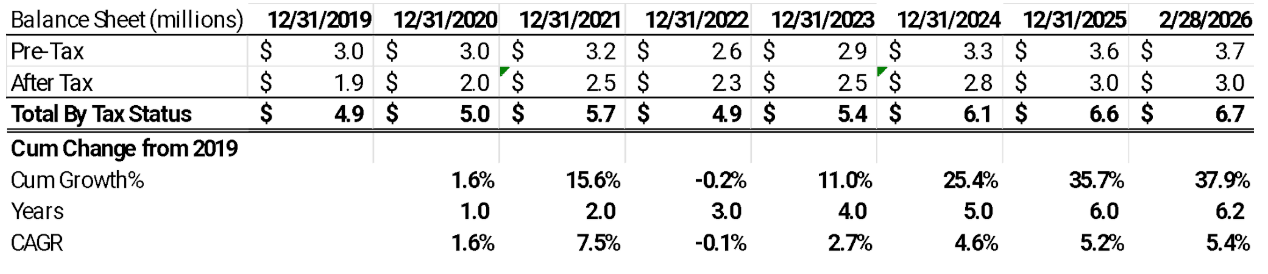
The table below tracks our balance sheet financial accounts since the end of 2019. The compound annual growth rate (CAGR) is currently 5.4%.
Keep in mind this is actually a Net CAGR since we are living off this portfolio, converting funds from deferred pretax to after tax, and paying taxes. Reading between the lines, it is totally possible to die with multiples of your initial retirement portfolio if you don’t get your spending up or give it away.
We will start drawing my wife’s Social Security after we reach Medicare age to avoid Income Related Monthly Adjustment Amount (IRMAA) additional premiums and take advantage of selective Roth conversions to utilize low bracket space filling the 12% and some or all of the 22% bracket.
We plan to draw my Social Security at 70 to maximize the life benefit for the oldest survivor.
How often do you monitor/review your portfolio?
I do a high-level review every month while updating the Balance Sheet. This usually amounts to some minor rebalancing and cash management transactions to maintain liquidity.
Strategically, we have moved closer to a 70% Equity/30% Fixed+Cash goal, and today we are sitting at about 73/27. Two factors have helped to move allocation between Pre-Tax and After Tax; the natural payout of deferred compensation, and secondly, owning more of the fixed income portfolio within retirement accounts.
This second point stated differently moved the ratio by holding appreciating equity in after-tax accounts.
After tax accounts are utilized to fund living expenses and planned purchases.
NET WORTH
How did you accumulate your net worth?
The biggest driver by far in obtaining our net worth was my income. I’d like to say we invested well, but truthfully, we invested OK’ish and learned some lessons the hard way.
Top Line fixes soooo many problems with other areas. Our retirement accounts were invested too conservatively for years and my brokerage account investing was hit or miss.
I learned some hard lessons during the .com bubble and I later adjusted and thought I had it all together with a “blue chip strategy.” That too was flawed with over exposure to companies that were later removed from the Dow Jones Industrials average. Another shortfall was an overweight position in employer stock.
What would you say is your greatest strength in the ESI wealth-building model (Earn, Save or Invest) and why would you say it’s tops?
Earn is tops.
This fuel took care of less than optimal investing and allowed significant savings (when matched with living below your means) that continue to power our net worth growth today.
What road bumps did you face along the way to becoming a millionaire and how did you handle them?
Career bumps were the toughest. While always employed, it was not smooth sailing at the office.
Multiple corporate buyouts and nearly losing my job under an ineffective president was trying, but a mentor saved my job and I learned the humility of working at a company after a high-profile demotion. Within 6 months, that mentor created a role for me in another area of the company to address a new business need and after a few years, my compensation recovered.
What are you currently doing to maintain/grow your net worth?
We continue to remain invested in equities 70+% and spend less than 4% but anticipate growing our spending. It will be difficult when the portfolio begins to decline from our spending later in life, but we want to enjoy these early retirement years.
I may not have the guts to execute, but I would like to see us spend or give away 5% of our portfolio each year for the next 5 years.
Do you have a target net worth you are trying to attain?
I’d like to see $10 million as a peak, but it’s just a number. If we aggressively grow spending and legacy giving, we may not see any growth.
As I finalize this document and have updated our March balance sheet, we are down $240k from the numbers I presented for February 2026.
How old were you when you made your first million and have you had any significant behavior shifts since then?
I remember calculating Net Worth after reading The Millionaire Mind by Thomas Stanley and it seems like we hit $1 million by our late 30’s or maybe at 40. We just kept doing what we were doing and as the top line grew, wealth began to accumulate.
We bought a few nicer things (second home) that we as a family really enjoyed but continued living well below our means.
What personal habits and/or traits have you developed that have made you successful at growing your net worth?
Patience, consistency, contentment. Dollar cost averaging (DCA) has been a huge driver in the growth of net worth as well as owning cars for long periods, paying cash, and staying in a home for a decade or more if possible.
Automating Saving and Investing is super easy with today’s technology. Setting up regular deposits and investing in low cost indexed Mutual Funds or ETF’s is a simple and effective way to passively grow net worth.
What money mistakes have you made along the way that others can learn from?
I would sell all stock options and restricted stock when it vests and diversify to broad index funds. This would be my hard rule even if I worked for NVIDIA (well I would at least sell half).
I would have invested 100% in low-cost broad index stock funds in 401k accounts and after-tax brokerages for investments until the late 40’s and then would start to segregate risk buckets for early retirement spending.
We bought a variable whole life (VWL) policy along with term coverage in my early 30’s. I would kill to have the VWL premiums invested in the VTSAX or SP500 all those years.
We also bought term policies and that is all I would have done in hindsight.
What advice do you have for ESI Money readers on how to become wealthy?
Time is your friend. You do not need to live a life of deprivation, but if you consistently save a significant portion of your income and resist new car/new house habits, you WILL be a millionaire.
Personally, any couple that works for 30 years should have a pair of 401k accounts above $1 million if they invest appropriately and their company has a nice matching program.
Really know your spending, this will help you anchor on a spend number and 25X to set your goal for investments. When we surpassed 30X spend in our investments, early retirement started to really occupy my mind.
FUTURE
What are your plans for the future regarding lifestyle?
As you know already, our net worth allowed our early retirement in our mid 50’s. Make no mistake, the decision to walk away from a career at your peak earnings is not an easy one.
The “one more year” syndrome is real and moving the goal posts when considering how much is enough can be a perpetual cycle. I remember setting a minimum goal of $3.0 million and then a safe buffer goal of $3.4 million.
Sequence of return risk scared us mere months after I retired losing almost $1million of portfolio value in the covid shock during the first three months of 2020.
What are your retirement plans?
Our plans for the future include more travel. I’ve added extended family big trips every other year for several Go-Go years, including potential grandchildren additions.
We have owned several boats and an RV in the past and will likely get back into these hobbies and try other new ones. We stay active in leadership positions at our church and other non-profit organizations.
We have enjoyed giving to organizations and occasionally surprising friends with gifts to charities they serve in their honor. We will continue to spend quality time with aging parents.
Are there any issues in retirement that concern you? If so, how are you planning to address them?
We have managed our own finances but are smart enough to know there are things we don’t know. The drawdown or decumulation period is turning into the most complicated phase of personal finance we have witnessed.
It is easy to save a pile of money in several different buckets (this alone opened many possibilities) but it is not so easy to manage income and capture ACA credits and avoid IRMAA. Roth conversions seem over emphasized, unknowingly I rolled over a significant 401k to an IRA and slammed the door on a potential Mega Backdoor Roth conversion.
Achieving every possible tax saving opportunity can lead to analysis paralysis. My thinking is that we will begin drawing down pretax funds in a measured way and minimize future Required Minimum Distributions (RMD) concerns.
The allocation of Equity positions in After Tax accounts means that our Pretax accounts should not grow as fast anyway.
It seems of late that there have been increasing articles on how many “good years” you have in retirement before the natural aging health issues push you into Slow-Go and ultimately No-Go phases. These bring an awareness to the urgency of doing more bucket list items sooner.
I have some strenuous goals that require action sooner rather than later. As I learned from my octogenarian father a few years back, “…when you get to the point you are measuring your first ‘last time I will _____’, the speed of life accelerates.”
I still have things I want to do for the first time, and the now is the season to make those happen.
MISCELLANEOUS
How did you learn about finances and at what age did it “click”?
An upper-level finance class and my trusty HP12C helped me grasp compounding and tap in many “what if” scenarios to model portfolio growth over time (I’ll confess that I did this during long meetings to visualize the day I would walk out the door).
Who inspired you to excel in life? Who are your heroes?
A tough military boss pushed me the most in my career. He was one of those “Good enough is not good enough” kind of supervisors.
He taught me you could never be over prepared and that served me well at key points in my career whether preparing for an interview or a board meeting presentation.
I think the biggest thing growing up in the 70’s middle class is that you innately were driven to succeed. ‘Go to school, make good grades, go to college, get a good job’ was just the expectation.
My dad was also very inspirational; he worked for a large global industrial corporation. Our family moved twice with his company when we were very young and then settled down before any of us finished grade school.
I witnessed dad at the table by 6:30, eating breakfast, reading the paper, and heading out the door by 7:00 usually carpooling to the office. He would return home by 4:45, set down his samsonite briefcase, and shoot a few hoops with us in the driveway or if it was baseball season, he coached our little league team.
Self-motivation to have the life mom and dad gave us was kind of the minimum goal.
Do you have any favorite money books you like/recommend? If so, can you share with us your top three and why you like them?
#1 The Simple Path to Wealth – JL Collins. Since retiring, we have embraced low-cost broad market index funds. A committed investment policy guides us, and market volatility no longer steals brain power or hijacks emotions. This approach would have been game changing 20 years ago.
#2 The Psychology of Money & The Art of Spending Money – Morgan Housel. These books have provided insight and help to optimize our retirement years. I often talk about making the most of our “Go-Go” years, but these books provide understanding and help us take action.
#3 The Millionaire Mind – Thomas Stanley. This just happened to be his “new book” at the time in the early 2000’s. We were living life well below our means and hearing how actual millionaires lived only confirmed we were on the right path from a spending and lifestyle perspective.
Stealth wealth is real but it would be nice to have an inner circle of peers to talk through financial issues and approaches. This cemented the philosophy that guided us to financial independence before FIRE was an acronym.
Do you give to charity? Why or why not? If you do, what percentage of time/money do you give?
We support several charities primarily utilizing a Donor Advised Fund (DAF). Several years ago we established the six-digit fund primarily with appreciated securities and used bundling to make tax-deductible additions.
At the time we were in the top tax bracket, and this was an effective way to support organizations we cared about while reducing taxes. We have made contributions to the DAF during 3 of the last 7 years and returns of the fund investments allowed us to give more.
We support charities with both our time and resources and serve in leadership roles. My goal is to increase the number of hours in this area.
Do you plan to leave an inheritance for your heirs (how do you plan to distribute your wealth at your death)? What are your reasons behind this plan?
We plan to leave something for the grandchildren assuming we reach our eighties but are already distributing some of our wealth to our kids families and helping with 529 accounts. We want to help them when they can benefit most and we can share the joy it brings, rather than leave a pile of money when they are in their 50’s and have already figured out the hard stuff.
If one of us die near term, a sizable portion of the financial estate will go to our adult children. There will be adequate assets and real estate for the surviving partner to enjoy a fruitful, secure and joy-filled retirement.

Leave a Reply