
 Today I have an update for you from a previous millionaire interview.
I’m letting three years pass from the initial interviews to the updates, so if you’ve been interviewed, I’ll be in touch. 
This update was submitted in March.
As usual, my questions are in bold italics and their responses follow…
OVERVIEW
How old are you?
I turn 64 this year, my wife is 68 and we have been married 35 years.
Do you have kids?
No children.
What area of the country do you live in (and urban or rural)?
We divide our time between a suburb of a major city in the Northeast, and just outside a medium-sized Southern city.
What was your original Millionaire Interview on ESI Money?
Is there anything else we should know about you?
We are somewhat a study in contrasts: we live below our means, our cars are 8 years old, and we complain about the price of groceries. At the same time, we stay in nice hotels, eat in nice restaurants and fly first class.
Given our lifestyle, money is not the issue. But we’re wired to be mindful of how every dollar is spent and that has served and will continue to serve us well.
We have kept our Northeast home, which we purchased when we got married, and paid it off in 2004. Several years ago, we did a to-bottom upgrade: new HVAC, kitchen, floors etc…at a cost of ~$125k but worth every penny.
We have also done some things that are contrary to conventional wisdom: for example, we upsized our home – actually, our second home. We purchased property relatively inexpensively and built the house of our dreams, and it is probably more home than we need but we love it.
As soon as we were able to and throughout our working lives, we maxx’d out our 401(k) contributions so over a 35+ year career we were able to build our tax-deferred balances significantly. When I reached a certain income level, my company enabled me to contribute, on an after-tax basis above the IRS limit into a separate 401(k).
When I left the company, these after-tax contributions were rolled into a Roth IRA.
NET WORTH
What is your current net worth and how is that different than your original interview?
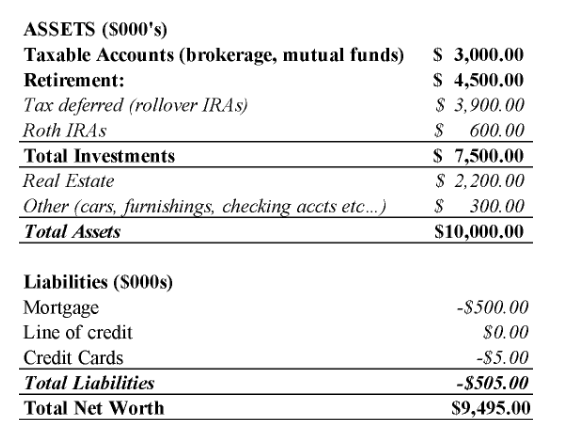
Our overall net worth grew +18% since the last interview while our investments grew +14.1%. Our growth was due to a combination of a strong market, reduction in liabilities and real estate appreciation.
Note that our investment growth was driven by performance of our rollover IRAs while our taxable accounts were relatively flat, as were our Roth accounts.
What happened along the way to make these changes?
We have, for the most part stayed the course. The biggest change is to our investment strategy, focusing more on yield and income vs. growth, and that is why our taxable and Roth accounts have grown modestly but our income from these accounts has increased.
While we take distributions from all accounts, from the taxable accounts dividends/capital gains are taxed at a lower rate and muni bond interest is tax-free, as are distributions from our Roth accounts.
Distributions from our rollover IRAs are taxed as ordinary income and we are mindful of the tax exposure which is why the taxable, and Roth accounts are our priority in terms of income. We have done some strategic divestitures but in our taxable accounts we are careful since many holdings have experienced significant growth and this would trigger a sizeable tax bill but that is also where we can, as needed do tax-loss harvesting if needed.
We paid off our line of credit – we drew on this for a home improvement project, and we keep our credit card debt low. We pay our credit cards in full each month and do not have any debt other than the mortgage on our Southeast home, which is by design: the rate is 2.75% and the interest is deductible.
What are you currently doing to maintain/grow your net worth?
Overall, we are happy with our investments and as mentioned, we live relatively modestly outside of dining and travel. We tend to be risk-averse investment-wise, and with few exceptions invest in things we understand.
We’ve increased our overall yield to approximately 3.3%. Bear in mind, higher yield does not always mean higher risk.
For example, certain sectors have traditionally higher yields i.e. Pharma and Energy. The traditional companies with which we are invested are solid, have been and will be around for the long haul.
They may not experience explosive growth, but they are reliable income producers. We bought many of these holdings years, even decades ago and they have appreciated considerably.
EARN
What is your job?
We have both been retired for approximately 11 years. When I say ‘retired’, ‘were retired’ is a more accurate characterization.
We were told our time was up (ageism, some late-career missteps, changing corporate landscape), given a severance and that was that. Since, in corporate years we’re dinosaurs, finding another job was a frustrating endeavor.
We did some consulting for a minute and then decided we were done.
We ended our careers in middle management – me as a department head leading a team of 5 people in a large multinational company, and my wife leading a team of 10, also in a multinational company. We were good role players, had satisfying careers until the end, with great compensation packages and benefits.
What is your annual income?
Our income from all sources is projected to be >$300k. When Millionaire Interview 313 was published our total income, exclusively from investments was ~$190,000.
One decision I had made was to take the lump-sum option in one of my larger pensions. We invested this lump sum and fortunately I came out ahead vs. taking the monthly pension.
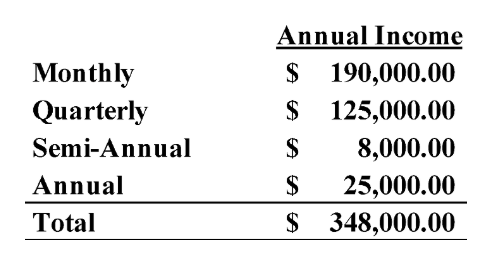
We treat all sources of income as ‘paychecks’ so it is important for us to have a steady stream of reliable income. One variable we always consider with investments beyond cost (for funds and ETFs), yield and safety is payment frequency.
Below is our income ‘flow’ across time periods, bearing in mind that the income earned semi-annually/annually is due primarily to mutual fund distributions and this can vary:
How has this changed since your last interview?
Several major changes: as mentioned, we have sought out and invested in more income-focused, vs. growth-focused holdings.
We have held most and/or have added to our current positions, a mix of broad-market ETFs and mutual funds, bonds (corporate, muni and gov’t) and blue-chip stocks.
Have you added, grown, or lost any additional sources of income besides your career?
We modeled the impact of taking social security – my wife at FRA, me at 64 and found our sweet spot. My wife had already started taking her modest pensions and I also decided to take mine.
I thought it would be better to take it now because…why wait? I could direct the money towards paying for healthcare or expenses and invest any remainder in a tax-free holding.
My wife took her pensions several years ago and I decided to take my pension this year. We direct my pension to our monthly health insurance premiums.
SAVE
What is your annual spending and how has it changed since your interview?
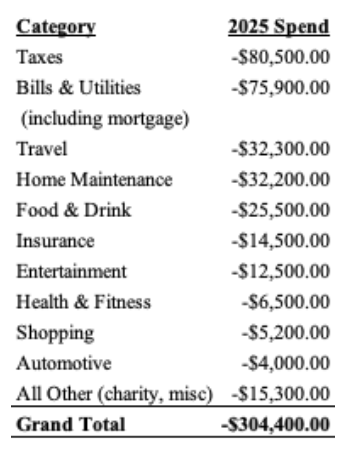
Last year we spent approximately $300,000. Outside of our mortgage, our biggest expense was taxes.
Last year we also had some one-time home expenses (HVAC issues etc…). We also travelled more, taking both large and small vacations and we have opted to fly vs. drive to our Southeast home and rent a car for the duration.
This year and going forward we expect our spending to be lower since we don’t anticipate, barring any surprises and outside of taxes, any large one-time expenses.
We may lease two new vehicles, keep one of our current vehicles to leave at the Southeast home so we can fly and not have to rent a car when we visit. At that time, we will likely tap into the annuity and direct towards the monthly lease payment but only after we exhaust the proceeds from the one vehicle we trade in.
When I turn 65, we expect our health insurance spend to be lower, even with the IRMAA ‘penalty’. Fortunately, I am in my last company’s retirement plan, so we have access to Medicare Advantage at a (relatively) reasonable cost through the same carrier I used when I was working.
What happened along the way to make these changes?
We came to the realization that based on our lifestyle we had sufficient income and we had, at that point lost our ‘mojo’ when it came to full-time work, so we remain happily retired. We had pondered working part-time at things we enjoy but given our dual ‘citizenship’ in the Northeast and Southeast it would be unfair to any employer.
INVEST
What are your current investments and how have they changed over the years?
Our current allocation by income type is as follows and it has mostly remained consistent though the holdings themselves have changed.
Mutual funds are generally large, consistent performers that have delivered consistent performance, and are relatively low cost with reliable income in good and bad years.
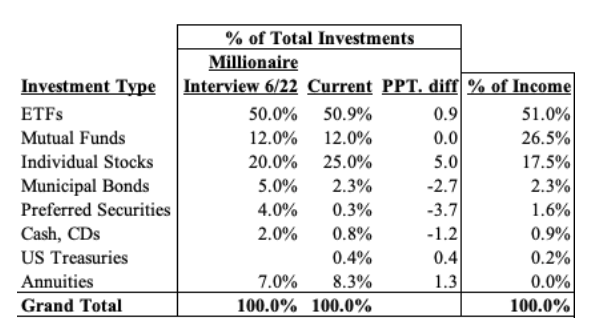
Across sectors, our allocation is as follows, and this has remained relatively consistent. Most individual stock holdings are dividend aristocrats and are well-known names across key sectors.
I recognize that we are equity-heavy, but I balance with both reliable holdings that tend to be recession-proof, and with fixed income. There is also overlap, between individual holdings, funds and ETFs.
The table below excludes mutual funds, since these funds are generally broad market and across categories.
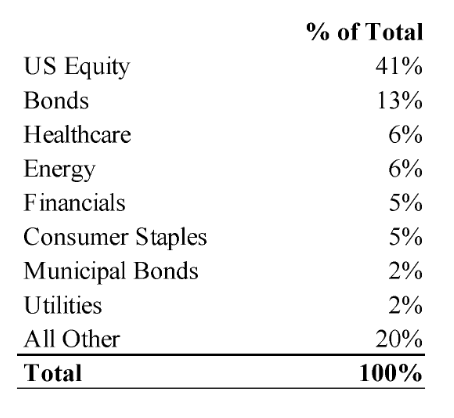
Our ETFs drive a significant portion of our investment income, and most are broad market with some sector
What happened along the way to make these changes?
We have made some investment missteps, some ‘what-were-you thinking?’: selling Nvidia in 2022 before it was NVIDIA and selling META when it was underperforming. But I also recognize that between both broad-market and sector ETFs we have these holdings.
My rationale at the time was/is that their yield is very low. Of course, the counterargument would be, take the growth and invest in something else.
We’ve had most of our holdings for many years. Some buys were a mix of luck and good fortune.
At the same time, we have made some strategic divestitures for tax-loss harvesting and/or to move to better yielding and better performing investments, mostly ETFs vs. individual stocks with emphasis in our taxable and Roth accounts. Currently, I direct excess cash to more tax-advantaged investments i.e. a tax-free muni ETF or fund.
MISCELLANEOUS
What other financial challenges or opportunities have you faced since your last interview?
Our biggest challenge, now and in the future will be taxes. We may be in the “nice problem to have” phase: many of our investments have done extraordinarily well and if we were to sell them, we would incur a significant capital gain tax bill.
The bigger question is, why would I sell an investment that is doing well and providing income? I sell and buy strategically and/or to harvest tax losses, reinvest if a bond or CD comes due but mostly, we’re buy-and-hold.
We also look strategically for high-yield investments in Roth and taxable investment accounts since the income is tax-free or at a lower tax rate.
Fortunately, our income from investments and other sources are more than sufficient to support our lifestyle, and we have not had to sell or divest any assets to pay debts.
At the same time, if we were to more aggressively do Roth conversions – at least enough to make it worthwhile to reduce RMDs, that would be exceedingly burdensome since that would be taxed as ordinary income. So…it’s a catch-22 or pay now/pay later: If I do Roth conversions now, they’ll be taxed as ordinary income, or take RMDs later and be taxed as ordinary income.
We have opted to hold. If I were to do it again, I probably would have done Roth conversions sooner; we are now well past the point of no return.
Overall, what’s better and what’s worse since your last interview?
Overall, our net worth has grown, our income from investments and from taking Social Security is more than sufficient to support our lifestyle which, by most standards is relatively speaking, modest. We are travelling more, we have hobbies that we enjoy – my wife takes online courses in history, and I am working with a language tutor to learn another language.
What are your plans for the future?
Eventually, our Southern home will be too burdensome to maintain so we will likely downsize to a lower-maintenance home, with in-house amenities etc… However, we will likely remain in the same geographic area and keep our Northeast home as a getaway.
We have roots in the area and if the weather – always a wild-card – does what it tends to do – we have a place to land. The Northeast home was paid off long ago and the annual maintenance is relatively low.
Beyond that, assuming we remain healthy we will continue to travel until it becomes too challenging physically and mostly, “keep on keeping on”.

Congrats on your continued success! It’s good to see how you spend on things that bring you joy like your dream home and travel.
I’m curious how you think about estate planning with no children.
Hello and thank you for the kind words. Regarding estate planning and few heirs it actually simplifies things, not having to worry about setting up trusts etc…
Our heirs will receive a portion of the estate but the bulk will be left to charities and worthy causes we’ve identified that are near/dear to us.
Best of luck,
Thanks for sharing! I liked the comment, “Our biggest challenge, now and in the future will be taxes. We may be in the “nice problem to have” phase: many of our investments have done extraordinarily well and if we were to sell them, we would incur a significant capital gain tax bill.”
Of course, I’d rather not have to pay taxes, but having more than enough money to pay what is owed is far better than not having enough money to live on and enjoy life. Unfortunately, many people who never engaged good stewardship including consistent gainful investing find themselves in the latter position.
Continue to enjoy the fruit of your labors!
Thank you so much for the comments and kind words.
We’ve all read horror stories about poor planning and not effectively planning ‘the long game’. I’ve perpetually suffered from FORO (Fear Of Running Out) – I panic when I’m down to 1/4 tank of gas – so I’ve planned accordingly.
Best of luck to you!
Great update! Since you don’t have any kids, are there any plans for how you will use the very likely, large excess wealth that you continue to accumulate?
Hello, thank you for the comment and question.
Though we have no children, we do have several heirs and we have identified charities/ worthy causes that would receive the proceeds.
Hello and thank you for the comments and question.
We have several heirs but we have also identified several charities and worthy causes so the proceeds will go to helping others less fortunate.
Best of luck to you!
Thank you for sharing the progress! What was your net worth when you retired? Did you move to an income/dividend investment approach right away or over time?