
 Here’s our latest interview with a retiree as we seek to learn from those who have actually taken the retirement plunge.
If you’d like to be considered for an interview, drop me a note and we can chat about specifics.
This interview was conducted in July.
This is part two of the interview. If you missed the first part, check out Retirement Interview 61 to catch up before you read this post.
As a reminder, this interviewee also writes regularly (with some great insights!) on her own site.
My questions are in bold italics and their responses follow in black.
Let’s get started…
RETIREMENT LIFE
How was the adjustment, especially the first few months after retirement?
It was glorious. The first six months felt like a weird, cozy, liberating fog. It was wonderful to just wake up and do whatever I wanted.
For the first time in my life I had no responsibilities, no schedule, no one observing me. It was a relief I didn’t know I needed.
I thought I would quickly tackle some new goals and endeavors – write a book, start a business, travel the world, get in great shape. But I didn’t do much of anything for 6 months.
I walked for miles listening to every last podcast that sounded interesting. I reread my favorite fantasy novel series, lying in the sun for hours on weekday afternoons.
I slept for 9 hours a night and had a 2-3 hour morning routine of coffee, journaling, reading the news, and scrolling Instagram. I sipped wine most nights and didn’t worry about it.
I redecorated parts of my house, walked to Whole Foods near daily for whatever looked good, and went on a couple of spiritual retreats.
I actually started to get worried that I was much too OK with doing “nothing” and being alone. I didn’t feel any drive to “find my purpose.”
I didn’t feel lost or sad. I felt free — and it was blissful.
The feeling hasn’t really faded. I don’t know if I’ve broached enlightenment or simply become untethered, but I don’t really care about much anymore – what I weigh, how much I earn, what anyone thinks, how my net worth is trending (easy to say in a bull market).
Most of the concerns I fretted about for years have just drifted away. It’s truly remarkable.
How is retirement life now? What do you like about it and what do you dislike?
Retirement life is great. I spend less and travel a bit less than I expected.
It turns out a lot of my activities were related to my job (or escaping/recovering from it). I knew this but was still surprised that expenses I thought were fixed now feel optional and even not worth the trouble.
For example, I budgeted for monthly massages and pedicures that I usually don’t bother getting. I love to travel, but now that I can go anywhere anytime, the drive to escape to far flung locales is diminished.
I can scratch a lot of the leisure and exploration itch without leaving town. I guess that makes sense given I basically now live a vacation lifestyle.
I love not setting an alarm and having full authority over my schedule. I don’t see myself ever giving that up.
To be honest, I prize this autonomy so much that it’s made me ambivalent about dating or getting another dog.
I do miss being surrounded by intelligent, driven people on a daily basis. I also know I benefitted from some of the forced human interaction of office life (as an introvert I adjusted very readily to a lot more alone time).
I also miss having a reason to get dressed up; I have a closet full of beautiful work clothes and shoes I collected over years that I guess I’ll eventually donate.
I don’t feel as “in the know” about sports, local events, new restaurants, what younger people are talking about. I read a lot, but being part of a multi-generational team kept me in the loop on many things that I completely avoid encountering on my own.
I feel like a much older person than I am as a result.
What do you do with your time? What does an average day look like?
My sleep cycle shifted a full 3 hours later. I go to bed around midnight or 1 am and wake up at 9 – 10 am.
I get some morning light, do Wordle, and scan the news and Substack.
Some days I get sucked into reading articles for hours over coffee; other days I light a candle or some incense, journal, and do a ritual around a seasonal holiday or the moon cycle. I have a few Zoom classes or gatherings a week as part of some online communities and courses I joined.
Midday I eat and head to the gym. I might hang out in the sauna or pool or walk for an hour or so if the weather is nice.
Next thing you know it’s time to watch sunset with my cat, shower and make dinner, and dive into whatever book or show I’m binging. Alternately, I’ll get dressed and head into the world for a date, book club, or dinner with friends.
If the calendar gets too empty I’ll walk to a nearby bar for dinner or gaze at my laptop from a coffee shop instead of home. Every 6-8 weeks I take a trip for 5-14 days.
I head abroad twice a year, visit family a handful of times in different locations, do yoga and other wellness retreats.
What are the major activities that fill up your time in retirement? Are there any new ones you’re planning to try?
I’ve been trying to develop a regular writing practice and started a Substack this year that has started to take off and keep me busier. I try to devote a couple of days a week to writing; I’m not good at doing a little bit at a time and instead get pulled into 8-hour marathon sessions.
I then wake up in the middle of the night with edit ideas. I need to learn to better harness the creative energy.
I would love to do some long slow travel, but until my two cats pass away (possibly not for 5-7 years) I’m unlikely to spend more than 2 weeks away from home at a time.
I would also love to explore writing and other subjects more deeply at conferences, workshops and seminars – possibly even degree programs.
I also offer financial consulting on a very part time basis. I have many weeks with zero activity, but sometimes I have a few meetings a week.
I’ve always spent a fair amount of my time offering free financial advice to anyone who asked, in online forums and in person. Being able to charge for it now is fun and allows me to write off expenses I would have anyway, like my CFP® Certification and health insurance premiums. But I’m not trying to make it another job.
What is your social life like?
I have a few friend groups and also my family on text chats, plus I’m on a dating app. I feel social via text, snapchat, or facetime on a fairly constant basis.
Many of my close friends have small kids so we only get together a couple of times a month. I meet up with other friends around once a week, and I’m in a book club and women’s circle that both meet monthly.
I’m also actively engaged in a few online communities.
I haven’t been in a serious romantic relationship yet, but I’ve been on lots of dates – maybe 3 a month on average.
Sometimes I’ll just hang out in public at a coffee shop, bar, the gym, my local park. It feels social, and I meet people and chat with neighbors I know.
I get big doses of interaction on family or group trips and hibernate for 3-7 days when I get home.
I take a quarterly family trip (or host) at minimum to visit siblings/parents. I have thought about moving closer to family, but we are all scattered.
So until someone needs extra care or I get tired of my city, I’m happy to travel to see them regularly instead.
Looking back, what would you have done differently?
I have always tended to hold onto things for too long – relationships, rental properties, jobs. Just because you can make something work doesn’t mean you should.
There’s a fine line between contentment and inertia, between dedication and fear of the unknown. I’m still learning to evaluate whether I really want something, whether it’s serving me, whether there are better options.
I maybe should have quit jobs sooner, let my husband go sooner, retired sooner. But I can’t really say I wish I had. I wasn’t ready, and I didn’t know what I didn’t know.
I wouldn’t have necessarily done better with the time.
I am glad I can look back and feel like I gave those efforts my all. I didn’t leave anything on the table. Now that those phases of life are over, I can relish the freedom without regret.
Was there any emotional impact from leaving the workforce?
I had no idea how frazzled my nervous system was. It seems inconceivable now to wake up to a blaring alarm, rush to work, and spend all day under fluorescent lights having dozens of conversations and fielding the pings of hundreds of emails, texts, calls, and Teams messages.
Not to mention the presentations, cold prospect lunches, and technology management.
Now my daily life is so much calmer. I have time and space to listen to my body.
I don’t beat myself up for skipping a workout if I’m tired; I don’t get stressed if I have a bad night of sleep.
I can just sit happily with my coffee and watch the squirrels play. I see why so many older people spend so little and also talk about how ‘busy’ they are with only a few appointments on the weekly calendar.
There is just so little I feel like I need now that I’m not coping, striving, competing, or on constant display.
What surprises (financial or non-financial, good or bad) have you had since retiring and how have you handled them?
I fully anticipated the bull market would end as soon as my paychecks did. I spent so much time worrying about the worst-case financial scenario that I wasn’t really prepared for a better case.
The note receivable paid out on schedule; some alternatives raised distributions; the market kept climbing. I’m getting a small unexpected inheritance from my grandmother this year.
I also truly didn’t intend to earn any money, but here I am watching a grand or two flow through my new business checking account each month.
I’m still wrestling with how to transition from a Type A achievement-oriented planner to someone who doesn’t need to earn money and has no long-term projects. Substack has been a great creative outlet, and my goal isn’t to monetize it – but sometimes I feel tempted to come up with a business plan and scale it and my consulting business…because that’s just what you’re supposed to do?
I’m trying to keep the focus on what serves me, giving back, and building community rather than setting arbitrary goals for the dopamine hit of a new subscriber or client.
What are your future plans?
I don’t know lol. I kind of hate this, but I also know this phase where anything feels possible won’t last forever – so I’m trying to just enjoy it.
I might be single forever or be in a serious relationship by Christmas. I might blog aimlessly for the rest of my life (which I did happily for nearly a decade anonymously in my 20s), or I could go viral and get a book deal one day.
I might never have kids or become a stepmom or get pregnant at 45.
I could get tired of consulting and totally quit or decide to take a dream job fall or business opportunity that falls in my lap (unlikely unless a major bear market spooks me into wanting steady income again, but life is long so never say never.)
Living in the moment feels recklessly wild after decades of long-term planning. But the outcome is the same either way: I don’t know what’s coming and I’ll figure it out as I go.
RETIREMENT FINANCES
How has your financial plan performed compared to what you had estimated before retirement?
My net worth has risen by about 20% in just over 2 years due to equity growth. I’ve spent 5-10% less than I projected. The plan is very on track.
I projected zero earned income but made $15K in 2025 and $23K YTD in 2026 from consulting. This could easily just fizzle out but could also keep rising.
Can you give us some insights into your post-retirement spending and income? How much do you spend annually and on what? And where does the income to pay for your spending come from?
Here’s a snapshot of my projected average annual expenses.
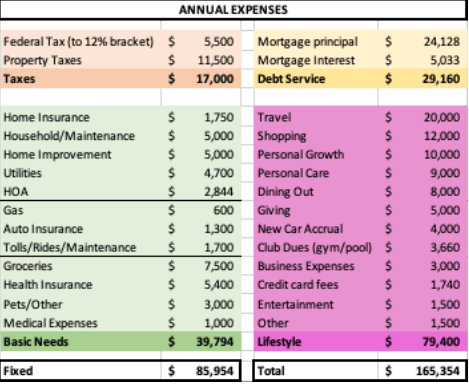
[Note on giving: this is mainly personal gifts to others. Charitable giving is primarily done outside this budget by gifting shares of stock directly; I also plan to set up a donor advised fund the year I sell a rental.]
The “income” is messy and harder to predict. Here is my projected cash flow, though these numbers may vary in amount and timing.
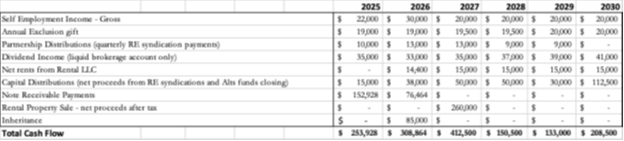
It’s weird to see the spreadsheet unfold in real time and the math actually work. Somehow the bills get paid every month, and it’s really not the ordeal I anticipated.
I do like that I have a variety of moving pieces that provide little bits of income.
Even though I set aside 3 years expenses in cash, it’s unlikely I’ll need to start dipping into that for years unless the alts and rentals all underperform. If things continue to go better than expected I may invest some of that excess or use it to pay for Roth conversions, especially if the market drops.
How are you handling Social Security, required minimum distributions, tax issues and the like?
My plan is to bunch property taxes and charitable giving every other year and file standard deduction in alternate years. I’ll claim social security at 70.
I’ll do Roth conversions as they make sense – if the market dips or I have negative ordinary income one year – but if I have to deal with RMDs in a few decades I will count my blessings. It will just indicate that one of the better financial (and longevity) scenarios played out.
I did $75K of Roth conversions in 2025 to offset my itemized deductions; I didn’t go up to the 12% bracket like I’d planned though. It was just too tempting to pay/owe $0.
I realized just under $50K of capital gains so stayed within the 0% tax bracket on that. So even with the big Roth conversion and some decent taxable dividend income, I ended up with zero net taxable income due to large deductions.
I may owe close to $0 again in 2026. I have a lot of rollover losses from years of RE syndications that will offset some income in the coming years.
My taxes are complicated with so many K1s though that it is really hard to estimate. Maybe I’ll let Claude try to forecast this for me with more precision soon.
But in general, I am just going to pay what I owe and try not to make optimizing my taxes a new preoccupation.
Did you return to paid work? Why or why not?
No, but I’ve started earning a bit on the side with the consulting. I love giving advice and have done so for free on financial forums and to anyone who will listen for as long as I can remember.
It’s fun to have an avenue to charge for it now.
I work less than 5 hours a week on average and have no intention of billing more than 10 hours a week. If I wanted a real work day again, I may as well go back to a job where I can earn 6 figures.
I don’t count writing as work, though a few dozen strangers have started paying to subscribe to my Substack. So I guess you could call me a professional writer?!
(At the risk of throwing all pretense of stealth wealth completely to the wind, feel free to check it out at melizabethgeorge.substack.com.)
I’ve taken a couple of recruiter calls about wealth management jobs and have not been even a little bit tempted. I think those days are gone.
Did you find it hard going from being a saver to a spender?
Not as hard as I expected, though that’s probably because my net worth is still growing. I’m sure it will be harder during bear markets.
It has been hard not to be buying when the market dips though; now that I’m not in accumulation mode, I’m just along for the ride on the asset value roller coaster.
I have upped my cash/bond holdings a bit so that I can rebalance during dips and feel like I’m doing something. That’s also when I might pull the trigger on bigger Roth conversions.
Looking back, what do you wish you knew in advance?
I don’t think there is anything I didn’t know that I do now – but I’m just 2 years in so the answer to this might change.
I’ll add my voice to the growing group of FIRE achievers and financial experts who look back and realize: I could have designed a life I love and quit the rat race sooner. The money worked out better than expected; I need less than I thought.
That reality isn’t inevitable and it may not last, but it’s been reassuring to experience so far.
What advice do you have for those wanting to retire?
If you’re reading this, you’re probably overpreparing for retirement and overanalyzing your finances. You’ll never have the perfect projections and can’t assure any outcome, but you’ll adjust as needed – just like you always have.
It also pays to remember that you’re probably much more likely to die than run out of money at any given point in the projections. Whenever I start to feel uncertain I imagine my elderly future self looking back; would she wish I’d skipped this experience or urge me to go for it?
We all want to cling to some sense of control, and rows and columns of carefully organized digital money are just the preferred coping mechanism for some of us. It can be liberating and healthy to let go a bit, but I did not expect retirement to make that easier.
After my nervous system had time to reset I found I am less anxious about everything, money included.
As for how you’ll feel, you can’t really know so don’t bother worrying about it. I thought I’d be spiraling with a lack of direction and overwhelmed by the options; I’m still in awe that I’m not (for now).
I don’t believe you have to retire “to” something, just like I don’t believe you have to have a good “why” to save and build wealth. If you are concerned you lack purpose though, don’t delay. You’ll have a lot more time and energy to figure it out in retirement.
So come on in; the water really is fine!

Thanks for sharing your experience and planning. Your annual expenses lists new car accrual. Is this for paying off a current new car or savings for a upcoming purchase? How many years per car? Either way i am curious about debt or planned savings vs just withdrawing same complete payoff amount from investments for the car? I guess is to better manage how much can be withdrawn at once for year’s income.
Also thanks for sharing idea about health insurance and write-off. (Like at least a 15% savings.) Too bad Christian health ministries cannot be written off.
The new car accrual is a bit of a shot in the dark. I have a paid off car that I bought in 2019 which cost around $30K. I’m in no hurry to replace it, and I barely drive, but I guesstimate that at a minimum I’ll buy a $40K car every decade, hence the $44k a year in the spreadsheet.
I don’t actually accrue/save for that anywhere. Most likely I’ll make large purchases like that in years with a cash windfall, such as the sale of a rental property or a large alternatives distribution. Or just from cash (I keep 2-3 years expenses in cash) during “good” market years like this one when I’m not otherwise tapping the cash pile. Time will tell!
I absolutely loved reading your interview. You really have a way with words. The part that really spoke to me was your answer to the last question. Thank you so much for sharing.
Besides BH & MMM forums, would love to learn more about the online communities you mentioned (as well as the Zoom meetings)!
Sure! Later today I have one with Ash Ambirge who offers various writing workshops and courses. I joined a year long thing that she’s not currently marketing, but there’s a weekly Q&A / convo with a small group of other writers I enjoy. I also joined The Living Temple which is a sacred feminine spiritual community (I’ve gone to some in person retreats with the founder which is how I found out about it). It’s a bit woo woo for many ESI readers probably, but they have all kinds of chats, dance classes, educational sessions and seasonal ceremonies (summer solstice, autum equinox, etc) you can tune into. And finally I am just wrapping up Launch Bestie which is a year long online marketing course which also has regular zoom workshops and Q&As. It’s been interesting to learn about that whole world, though I mainly learned that I don’t really want to launch online courses or figure out the world of social media and digital marketing lol.
“though I mainly learned that I don’t really want to launch online courses or figure out the world of social media and digital marketing lol.”
Hahaha. Welcome to the club.
Being financially independent has a way of putting a damper on any sort of activity that you’re not 100% interested in or up for.
Spoken as someone who is in their 5th year of “I’m going to start my YouTube channel this year.” lol
100%! It’s been interesting to learn about, and I can see the appeal, but I also feel bad for some of the other folks in these classes who are really trying to earn money online (and need to) and are desperately trying to stay in front of the algorithms and trends and pick the right platforms, etc.
I just want to write stuff that the people in my audience want to read.
I really enjoy reading whenever you post on MMM and ESI. I especially appreciate your frankness about doing nothing and not “really caring about much anymore.” I think it was an MMM post where you said something about thinking you were going to start going to the gym more but, nah, you decided you really didn’t want to do that so you weren’t going to.
Too many people pontificate about how one needs to have a “why” or purpose in retirement. I took 10 days off around the Christmas/New Year holidays last year and did almost nothing and it was glorious. I realized in that moment that I would probably sit like a lump on a log for at least the first six months in retirement (if not longer). And the thought brought me much happiness.
Thank you!
Bob Dylan’s definition of success is “ waking up in the morning and going to bed at night and In between doing what you want to do.” Seems like you are successful. Good on ya.
I enjoy your blog. Please continue to write.
Thoroughly enjoyed your story and writing – thank you for sharing! I read portions of your post aloud to my husband followed by, “I think I found my spirit human.” Lol. Your story inspired me to embrace the path I’ve been picturing and not caving to the naysayers (my family members) who say I’ll last 2 weeks in retirement before I get bored.
You never know until you try!! 😉
Thank you for your kind words.
Part 1 was so good, had to come back for Part 2. Then I read that line about previously having a blog in your 20s and I immediately knew who this was. A quick check of your substack confirmed I was thinking of the same person. I was such a big fan of your blog, it’s so good to have this update. You still have a gift for writing. I’m absolutely thrilled to hear that you’re living life on your own terms. Bravo!
Ah thank you for this! I sometimes wonder whether folks from the old World of Wealth days will make the connection. Deleting that blog is a big regret, but then Substack came along and gave me a chance for version 2.0. I’m still getting used to writing under my real name – as you can see from this interview my tendency is still to eschew any sense of privacy and bare all lol.
I found that it’s better the second time around. ESI is much better and focused (at least IMO) because I first had FMF.
Your ducks are not just in a row, they are organized in precision squadrons! I am some 40 years ahead of you, and I am fascinated by your trajectory. I, too, rarely set an alarm and absolutely love the freedom of retirement, though mine was a late one. Your message that you don’t HAVE to retire TO something is a powerful one, and freeing. Doing things because they are fun is reason enough: you don’t have to field an exhibition just because you like to draw and you can write without publishing for money. I have recommended your Substack to several friends. Kudos to you!
Many thanks for sharing this inspiring and sincere adventure. It is very interesting to have the point of view of a happy and fulfilled single woman.
Even from France, it is very stimulating and thought-provoking.
Take care and best.
Sincerely yours,
Hélène