
 One of the things I love most about the Millionaire Money Mentors forums is the people we have there.
Sure, we have a lot of very successful mentors who have accumulated enough money to become financially independent, but that’s only part of the story.
What’s even more interesting to me is what many of them are doing with the freedom their money has created.
They’re not simply retiring from work and sitting around the house.
They’re traveling the world, pursuing hobbies, volunteering, starting new businesses, spending more time with family, taking on interesting projects, and generally creating the retirement lifestyles they dreamed about while they were working.
And some of those lifestyles are pretty amazing.
I want to share many of these stories with ESI Money readers. Partly because I think they offer some great ideas for what retirement can look like, and partly because they’re simply fun to read.
Even if you have no desire to do exactly what these mentors are doing, you can at least live vicariously through them. 🙂
Today’s story is a perfect example.
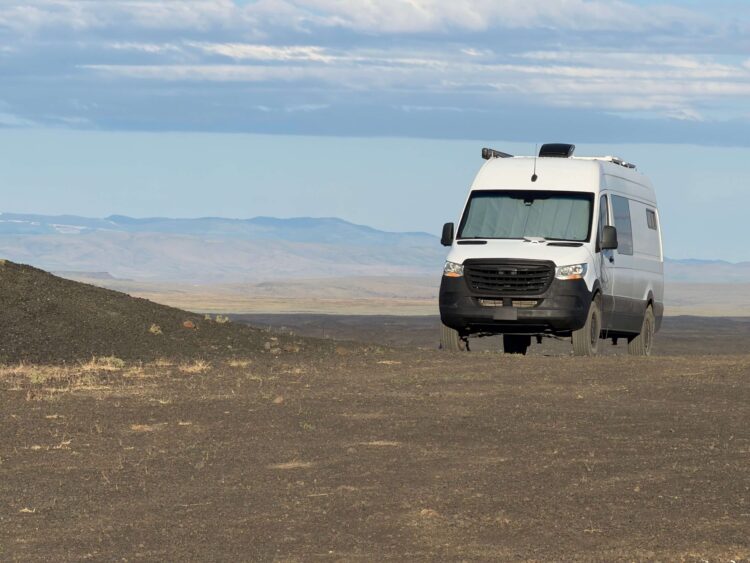
One of our MMM mentors and his wife love to travel. But rather than simply taking traditional vacations, they decided to build something that would allow them to travel differently.
So they bought a Mercedes Sprinter cargo van and spent six months turning it into what is essentially a small apartment on wheels.
And I do mean they turned it into an apartment.
They did the electrical work, plumbing, carpentry, solar system, furniture, upholstery, and virtually everything else themselves.
When they were finished, they had about $68,000 invested in the van and initial conversion. They’ve since added some upgrades, bringing their total investment to roughly $83,000.
Then they hit the road.
During their first year they spent 21 weeks traveling, drove more than 22,000 miles, visited 23 national parks, boondocked in some incredible places, traveled through much of the country, and even ventured into Canada.
Along the way they’ve learned quite a bit about van life — the good, the bad, the costs, the inconveniences, and what it’s really like for two people (and, initially, two dogs) to live together in a very small space for weeks or months at a time.
I wanted to know the whole story, so I sent him a rather extensive list of questions covering everything from how they got the idea to the actual van build, what it cost, how they travel, what daily life is like, what has gone wrong, what they’ve learned, and whether they would do it again.
As you’ll see, he gave me some great answers.
There was enough material that I’ve divided the interview into two posts.
So if you’ve ever wondered what it would be like to build your own camper van and spend retirement roaming around the country in it—or you simply want to live vicariously through someone who is doing exactly that — you’re going to enjoy this series.
My questions are in bold italic and his responses follow.
Let’s get started…
The Idea
Tell us a little about you and your wife and where you were in life when this idea first came up.
When my wife and I met in our early 30’s, we knew we had wanderlust in common. By our late 40’s we were well on board the FIRE train and closing in on an early retirement focused on travel.
That’s when we began toying around with the idea of selling our house and living in an RV.
Where did the idea of converting a van and traveling around the country come from?
Since my mid-20’s, I’d daydreamed of exploring the country — whether on a motorcycle, tent camping or in an RV. Turns out, our daughter inherited those same desires.
In 2021, she fell in love with Vanlife, so together the three of us bought an old delivery van and converted it into an apartment on wheels. By the time she graduated with her MBA the next summer, she was a full-time working nomad. As we watched her travel the country, we fell in love with the lifestyle.
What appealed to you about a converted van instead of staying in hotels, buying an RV, or towing a trailer?
Our initial interest in an RV instead of a house waned somewhat after we’d consumed hundreds of podcasts and YouTube videos — seeing the stories of full-timers in Class A or Class C RVs struggle with the limitations and headaches of the larger rigs.
We wanted greater flexibility — taking the less-traveled winding roads and avoiding RV parks in general.
Seeing our daughter’s van travels and joining her occasionally on the road, we realized that a converted van (known as a Class B RV) would meet the majority of our needs.
Had you done anything similar before, or was this a completely new experience?
Our most frequent vacations often involved camping — mostly in tents, but occasionally borrowing or renting a travel trailer.
We loved getting away from crowded places and out into nature, usually targeting national parks and forests.
Small RV travel seemed to offer an easier way to sustain this kind of travel into our 50’s.
Were both of you equally enthusiastic from the beginning?
One of our superpowers as a couple was that we shared many common interests.
That was especially true with our love of the outdoors and exploring. We both saw this as a new and exciting way to travel.
What concerns did you have before deciding to move forward?
Did we actually have the skills to turn a Sprinter cargo van into a nice RV? How much would it end up costing us to do the buildout? Could we comfortably coexist in such a small space with two dogs and each other?
We’d been aspiring minimalists for many years and were used to traveling light…but this would be a whole new world of small living.
Buying the Van
Tell me about getting the van.
In 2024, we purchased a 2WD 2019 Sprinter van with only 14,000 miles.
It was the 170” wheelbase — about 22 feet long, and tall enough that most people could easily stand inside it.
The original owner had started to convert it into an RV, but lost interest in the project.
Including taxes and registration fees, we paid $38,000, and the sale included about $8,000 worth of RV equipment, 2/3rds of it uninstalled.
Why did you choose that particular make, model, and size?
We’d researched the three most common Class B van platforms — Mercedes Sprinter, Ford Transit and Dodge Promaster. We chose the Sprinter primarily because of its powerful yet fuel efficient diesel engine.
One of the drawbacks for many buyers is its price — often the most expensive of the three vans. But we netted significant savings by buying a low-mileage 2019 from a distressed seller.
What other options did you consider before making your decision?
We’d looked at factory built Class B’s like the Winnebago Revel as well as DIY builds of various quality.
With my daughter’s van-build under our belt, we felt like we could be near the quality of the pro builds and not have to invest $150k+.
We did kick the tires of a few DIY builds, but had concerns with the quality of the conversion — “What’s behind the walls?” etc.
Looking back, did you choose the right van? Would you buy the same one again?
Yes, we love the Sprinter platform even more than we thought we would.
Because of its popularity in the RV and van conversion community, there are countless aftermarket products to enhance a buildout.
But some of the initial benefits we thought we were getting with this van didn’t turn out as expected. While the previous owner had already started the conversion, we ended up un-doing the majority of his work, primarily due to wanting a different layout and a desire to use higher quality components.
And of the RV equipment he included in the sale, we resold or gave away most of it for similar reasons.
But ultimately, because we saved so much in the purchase of the van, we were able to put more money into the conversion to dial in the buildout just how we wanted.
Planning and Building It
How did you determine the layout and decide what the van needed to include?
I am blessed with a spouse who has a gift for design and engineering.
With our previous experience building out our daughter’s van, and countless van tours on YouTube, we had a solid idea of what we wanted and what we didn’t.
We shared ideas with each other and my wife sketched out the general dimensions of the floorplan.
What were your must-have features, and what did you decide you could live without?
The drawback of a Class B van is that you can’t have all the conveniences of home. But we did have some basic expectations — enough electrical power for hot water and air conditioning, a functional kitchen with cooktop and counter-height refrigerator, split bunks for sleeping, a non-flushing toilet, and a dining table.
We also wanted our kitchen sink to drain to a gray tank underneath the van. While we could live without an indoor shower, we did want an outdoor shower hookup. And we wanted enough fresh water storage that we could boondock (camping without access to utilities) for 1 to 2 weeks.
We also needed enough space for us and our two dogs — a small Yorkie and a large German Shepherd.
About ⅓ of the way into the conversion, we decided to add additional features like a microwave oven, extra drawers, a cold water filter, and an exterior awning.
How much construction, woodworking, electrical, plumbing, or mechanical experience did the two of you have before starting?
In addition to the van-build with our daughter, we’d also done remodeling work in each of the previous seven homes we’d owned.
We are a bit slower than the professionals, but the end result is at a comparable level.
While I have basic knowledge of servicing a vehicle (fluids, brakes, etc), I’ve left all the mechanical work to automotive professionals.
Did you do the entire conversion yourselves, or did you hire professionals for some parts?
Yes, we did all of the conversion ourselves.
Six months after we finished, and after 10 weeks of traveling, we had a pro install an upgraded suspension to the van.
How long did the conversion take from the beginning until the van was ready for its first trip?
We began work in March 2025 and finished in September of that same year.
We left for our first trip one week later.
How did you divide the work and decision-making between the two of you?
We collaborated on most aspects of the build and divided the work according to each of our skill sets.
I handled electrical, solar, plumbing and carpentry, while my spouse did much of the finish carpentry, staining, painting, upholstery.
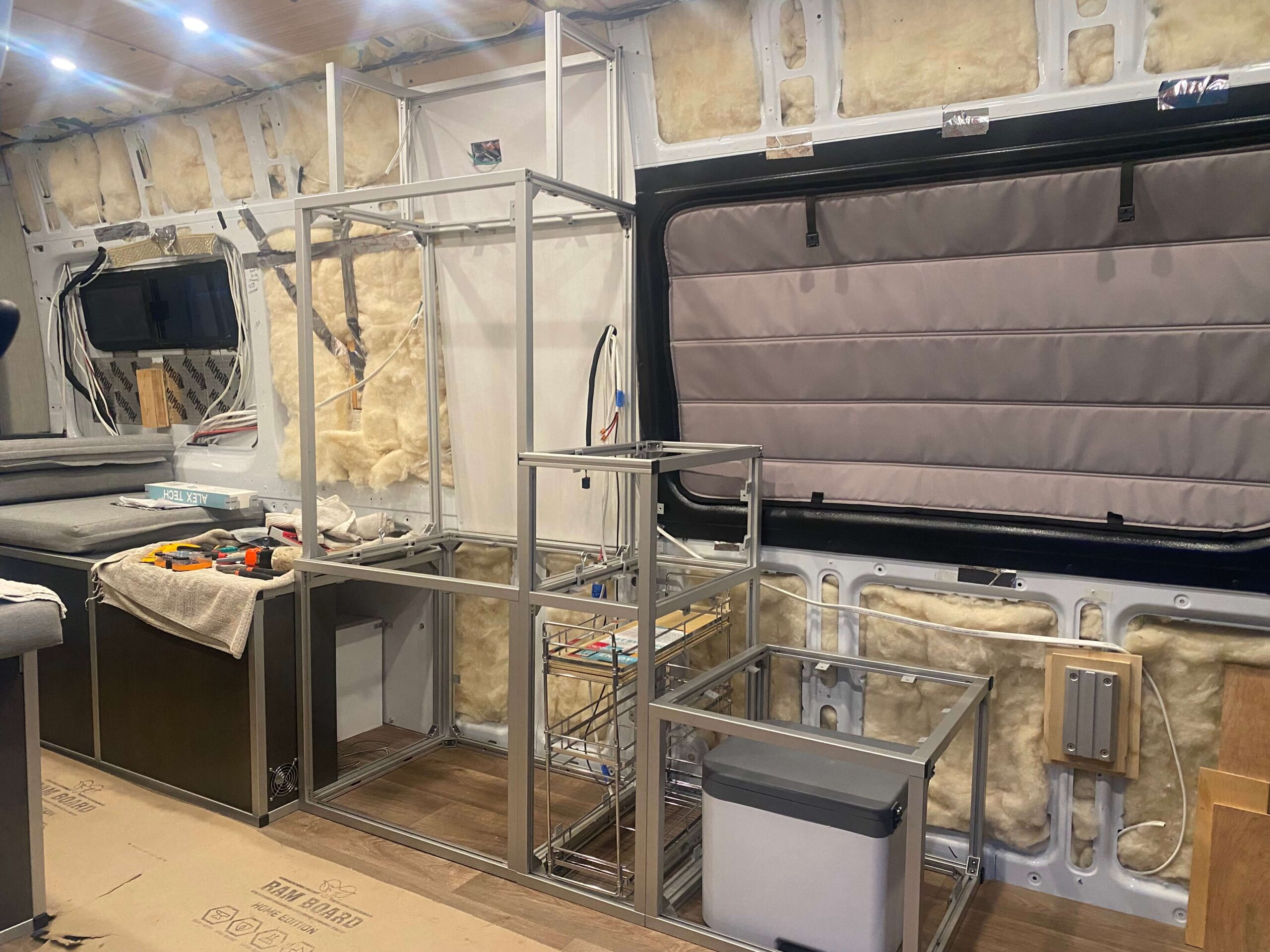
We built the furniture and fixtures out of plywood and extruded aluminum — using the aluminum to build the frame. Much of the construction of the furniture was done together.
We’d usually work on the van every day of each week, anywhere from 4 to 8 hours per day.
What was the most difficult part of the conversion?
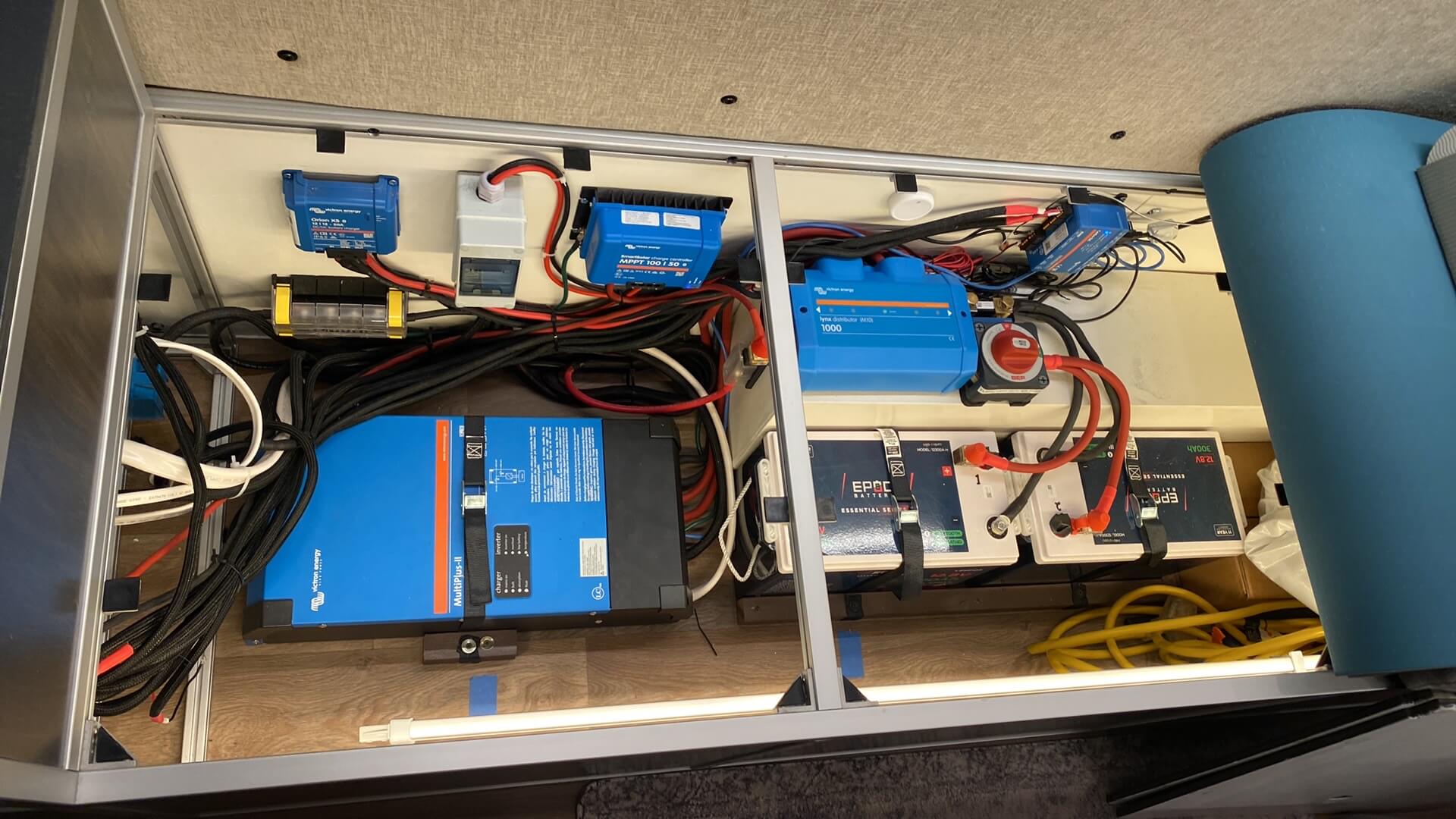
The most intimidating part was building out the mobile power system — lithium batteries, solar panels, fuses, inverter, hundreds of feet of electrical wire, etc. If not built correctly, it becomes a fire and electrical hazard that could injure you or destroy the van.
While I had built a smaller and more basic power system in our daughter’s van, this time I took a paid online course designed for van builders. That gave me the knowledge and confidence to build a robust power system that safely meets all of our needs.
What mistakes did you make, and did you have to tear anything out and redo it?
The previous owner had used solid copper wire (Romex) which is commonly used in building a house.
But in a van, your “home” is undergoing minor earthquakes every time it is in motion, which causes the solid wire to break.
I removed the wall panels, pulled out the Romex and replaced it with stranded copper wire.
What went especially well during the build?
The plumbing went very smoothly.
I’d purchased an expensive specialty tool that allowed me to easily use PEX-A pipe and fittings, which made the entire process a breeze. It also helped that I drew a schematic and laid out all of my fittings on the garage floor in advance.
Still, I had to make multiple trips to Lowes to get the right fittings.
What would you do differently if you were starting over?
We kept a few of the elements that the previous owner had installed — including two sliding glass RV windows in the rear.
If starting over, I would have used a higher quality window that allows them to be open when it’s raining.
The Costs
What did you originally expect the entire project to cost?
We’d estimated the buildout itself would cost $20,000.
Added to the $38k we’d spent buying the van, we were budgeting just under $60k for the entire project.
What was the actual total cost, including both the van and the conversion?
By the time we left for our first trip, we’d spent $32,000 on the conversion.
We netted about $2k from selling some of the equipment that came with the van. With the purchase price of the van, the total net spend was $68k by September, 2025.
But…after traveling for 10 weeks across three different trips, we decided to upgrade the suspension, add some exterior storage boxes and a few other items.
This added another $15k to the project, putting us at a grand total of $83,000.
Can you break the conversion cost into the major categories? Which parts of the build were the most expensive?
Aside from the $9k spent on the suspension system, the most expensive category was the power system — solar panels, lithium ion batteries, components, wire, etc came in at $6,500.
The largest single purchase in the initial buildout was an external awning at $2,300.
One expense we did not have was the air conditioner, which the previous owner had purchased but not installed. It was a high quality brand that sells for $3,500.
What expenses surprised you or caused you to exceed the original budget?
One of the harder parts of a van build is often where the walls meet the ceiling, especially around factory doors and windows.
These areas are often curved and some DIY builders leave them as bare metal or construct their own covers. But a few companies offer trim kits — molded plastic pieces that bolt right into place.
After much debate, we decided to spend close to $2k for a full trim kit. My spouse then upholstered each piece so it blended seamlessly into our van. It was a lot of money but in the end it was worth it.
How much money do you believe you saved by doing the work yourselves?
A new van with the same features as ours, built by a professional, would cost anywhere from $150k to $225k.
Doing the work ourselves saved us at least $75k.
Were there any purchases that turned out not to be worthwhile?
So far, the $2,300 awning.
We have not used it as often as I thought we would. But when we have used it on warm/sunny days, it does make a difference.
Do you believe the finished van is worth what you have invested in it?
I’m confident we could sell it for close to what we invested in it, not counting our sweat equity of course.
The re-sell market for upconverted vans is tricky, especially with a DIY van. We took a lot of photos of our build process, so if we decide to sell, the new owner can be assured it was built properly.
Taking the First Trips
Did you take a short test trip before attempting a longer journey?
We took a “shakeout” trip to a local state park for two nights.
The intention was to fully test out all the features in the van, but more importantly to help us refine the packing list.
A few days after that, we loaded up for a 3-week, 3,600-mile trip across five states.
What did your first trip reveal about the van or the lifestyle?
We loved it!
Our design was a success in meeting our needs.
The lifestyle was as good or better than we’d imagined, especially the ability to get off the beaten path and find more solitude to ourselves.
What did you bring that you discovered you did not need?
Too many clothes!
What did you fail to bring that you quickly realized was important?
I had brought a small collection of my tools, but realized I needed a few more tools and a better tool bag to fit in the van.
What problems did you encounter during your first few trips?
The reality of vanlife is that you often have minor repairs to deal with (see the earthquake effect referenced earlier!) But when you build out the conversion yourself, you usually can diagnose and fix most of the issues.
While we’ve had at least one minor repair each trip, our most memorable was during a winter trip through the southwest. On a particularly chilly night in the Arizona desert, the fuel line that fed our diesel heater failed. But the next day we hit an auto parts store and I repaired the fuel line in about an hour.
Knock on wood…so far we’ve yet to have any mechanical issues with the van itself.
How the Travel Works
How long are your typical trips, and how often do you expect to take them?
We have taken one major trip for each season, with shorter trips of 1 to 3 weeks during the Fall or Spring, and longer trips of 6 weeks to 3 months in the Winter and Summer.
How much time do you usually spend at home between trips?
Two to three months at home has been about right for us.
Enough time to rest and recover from life on the road, do projects around the house, and further dial in our van build.
So far we’ve returned from each trip with a short to-do list of tweaks or additions to the van.
How do you choose your destinations and plan your routes?
One of our favorite conversations throughout our 20 years together is “where do we want to travel next?!”
Our favorite regions to visit in the US have bountiful outdoor attractions — national parks, mountains, forests, rivers, etc. Because we focus on chasing 70-degree weather, we target more southern regions in the winter and northern regions in the summer.
We’ve traveled fairly extensively through the lower 48 in our lifetimes — 45 national parks and counting! But we love to revisit places, especially at a slower pace than our previous travels.
The van itinerary is often built around going slower and staying longer compared to our previous trips when we both worked full-time. In our first year of slower travel, we continually find new discoveries, especially in our country’s national parks, monuments and forests.
The other metric we use to decide where to go revolves around how crowded it might be. Yosemite National Park in January has nearly all the beauty of the summer, but 10% of the summer crowds.
For destinations during their peak season, like Glacier National Park in the summer, we aim for off-peak arrival times. We usually stick to state and US highways, avoiding interstates. As a result, we rarely travel through large cities, although have done some street camping in large cities like San Francisco.
Do you travel with a detailed itinerary or leave room to change plans?
We have slowly been changing our travel style from the pre-retirement days of “every-single-detail is planned for”…to the opposite in the van. On each van trip, we have a general idea of the states we want to visit, but only figure out our exact route 24 to 72 hours in advance.
This helped us be spontaneous. If we learned of something interesting, we could divert at the last minute and not worry about cancelling reservations.
A great trip is often a little luck and a lot of good decision-making. While we don’t plan far in advance, the decisions we make at the last minute are vital to the trip being successful. Deciding a route or making a campground reservation 24 to 48 hours in advance allows us to have the most up to date information to make the best decision.
Where do you normally stay overnight?
On average, we spend 35% of our nights boondocking — camping for free on public lands, often with scenic views in national forests or BLM lands (Bureau of Land Management.)
Our next most frequent stay (30%) is at a paid campground — mostly national or state parks.
Our third option is a Harvest Host — a membership program that allows us to boondock our van at a member location, often a winery, farm, museum or small business. In exchange for the free parking, members are encouraged to spend $30 with the host.
Our fourth option is staying with a friend or family member, either in their driveway or a guest room. While this only happens around 5 percent of the time, we really have enjoyed reconnecting to folks we would otherwise never see.
Our rarest stay would be at an RV park — maybe once every 3 weeks. When we do choose to stay at one, it would need to have an experience feature — like a natural hot spring.
How many miles do you typically travel during a trip?
A lot!
In our 21 weeks of travel during the first year after finishing the van, we’ve logged over 22,000 miles.
During our 11-week summer trip, we drove over 9,000 miles and traveled through 12 states, plus into Canada.
How much time are you comfortable driving in one day?
My preference is 100 to 200 miles in a day, although we’ve easily traveled 500+ miles in a day when needed.
I am the primary driver, although my spouse can drive if I need a break.
One of the reasons we can drive farther is that the van drives as comfortably as any large SUV or pick-up truck. Plus, we have a refrigerator full of cold drinks and snacks.
How easy is it to park, maneuver, and use as transportation once you reach a destination?
While it is longer and taller than standard vehicles, as long as we avoid drive-thrus, parking garages and tiny parking lots, it is easy to navigate.
Parking and setting up camp is much easier than with larger RVs or trailers, and certainly less work than when we were tent camping.
If we need to run an errand or get to a trailhead, we can be back on the road in less than 5 minutes.
As of now we don’t carry bicycles, so the van is our only transportation aside from walking.
——————————–
Pretty interesting stuff, right?
I love this because it’s a glimpse into a life I would otherwise have no exposure to.
To read the next post in this series, see Vanlife in Retirement: What Life on the Road Is Really Like.

Converted Sprinters are undeniably appealing, but even with standard “man math,” I can’t make the numbers work (I have tried!).
Between an initial investment typically pushing $140k, ongoing insurance, registration, poor fuel economy, off-season storage (a big one), and the constant hustle of finding a quiet, legal, and peaceful place to park overnight, the friction costs of ownership quickly pile up. Add in maintaining complex electrical and plumbing systems, and it feels like a second job.
When you look at the opportunity cost alone, the interest on that principal plus expenses could easily fund luxury hotel stays—complete with hot, high-pressure showers—without any of the logistical headaches.
Just my humble opinion – certainly happy for the couple that is making it work!
Another option is a minivan-based build. I converted a new Toyota Sienna for ~$55k all-in. In exchange for giving up the ability to stand up inside, I gained a (relatively) inexpensive RV that gets 40 mpg. It’s super-stealthy and, as a hybrid, it provides unlimited electricity.
I get it, and have struggled with the math of the price tags on Class B vans. And everybody has different travel preferences too – you can get three times the space in a Class A or C RV for the same price as some of these Class B’s. If we hadn’t saved so much building it out ourselves, I probably would never pulled the trigger.
For us, I enjoy the friction costs of ownership mostly because I like the challenge of learning how things work and trying new things. And I’ve been surprised how maintenance free most of the systems are – the electrical, for instance, has been a set it and forget it experience. It just always works.
Looking for a free spot with an epic view can be a fun challenge, although if we were full time I know it can get tiresome. And while we don’t have the luxuries of nice hotels, I love that my van can take me to even better views, and I don’t have to share it with 500 other guests.
Great share and it’s good to find kindred van life folks. I can relate !
I took a little different path back in 2022 after spending 7 weeks in my pickup with my dog skiing the west. I came home and bought a custom build. Looked at mid/low quality rebuilds like Revel and decided to buy the best I could afford. Dropped $185k and I have no regrets. I’ve never owned an aircraft or boat or fancy cars. I didn’t need to justify this – I simply wanted it. I ski and mountain bike so this is my home / transport.
I’m not retired – but I spend 12 -15 weeks a year out in my 144 Sprinter. Just drove to Alaska to look at investment from Tennessee. Fantastic ! 10k miles.
I use the van to scout for real estate so there was a sizable tax write off. It’s just been a great thing to have.
Mine is built around the bike garage beneath the bed and ski racks.
Just added a Starlink and that is fantastic.
We still jump into a hotel occasionally. But we don’t have to. 420 AH of lithium battery and a walkable solar panel on the roof keep us powered.
My van is probably worth 65% of purchase price but I don’t care.
Worth every penny.
Look forward to Part 2 guys !
We have had our 34 foot, 1998 Class A diesel pusher for 8 years now. We bought it for $24,500 and lived in it with two large dogs for 6 months in between houses and home states. We had a blast. Since then we’ve made improvements like in this story and can boondock for days and run an air conditioner for 10 hours off the batteries and solar without running the diesel generator. There are many RV’s of this vintage that are available on the cheap and well kept. If our engine ever fails us, we would just buy another RV as they are less expensive than replacing the engine. We have only 84,000 miles so that is unlikely. We see these diesels with several hundred thousand miles all the time so ours is barely broken in.
My wife and I are reading this post as we sit in our 2026 Coachmen Beyond class B van on a Ford Transit. We are spending the night in Indiana Dunes National Park and then off to explore the coast of MI, the Upper Peninsula, then off to North Dakota and down to Denver to spend a month with our daughters family (grandkids). We love our coach with no regrets on the purchase (and I’m a retired Finance executive). We love the freedom it gives us to travel. You can’t take it with you. Enjoy the experiences!
my wife and I have take 2 trips in rented class B campers (Alaska and Glacier National Park) and are gearing up for a 3rd 10 night trip in early September through Southern Utah. We’ve loved the experiences. While we don’t want to live full time or even part time in a van, we have worked with our fee only financial planner to incude the expense in our retirement budget, and using that will figure prominantly in our travel budget when we retire in the next few years.
I’m handy, but since we moved to a townhouse, I don’t really have an easy location to work on ourfitting the van myself, have other projects I’m building (furniture for our place) and some of the work seems more than I want to take on (not eager to cut holes in a perfectly good Mercedes Sprinter), so lately we’ve been watching alot YouTube video reviews.
There are a number of builders out there with many many options from utilitarian to semi custom to full custom, and also something we’ve not considered before including truck over type rigs with a full fiberglass insulted shell in place where the pickup be would be. We are currently making a list of things we would prioritize, and were hoping we could fir everything in a 144″ Sprinter, but even the Loft model from rossmonster out of Loveland CO, we won’t be able to get the critical wants, so it looks like the 170″ will be our choice.
One question I have is how much water you use in 1-2 weeks of boondocking. do you refill the tanks during that stretch? How did you figure how much battery/solar to use, and what have been the biggest challenges with the van in terms of things you wished you did differently in the build?
Renting is a great way to go – helping you figure out what you want or don’t need. And yes, there are so many pro builders these days – definitely a variety of options and budgets available. Water usage – I have 40-gallons of fresh water and it will last for at least 2 weeks if we don’t use the van for showering. So basically drinking, cooking and dishes. For building the power system, I used an online calculator to determine what our power usage would be, and used that to figure out how much battery storage I’d need. For solar, you’re limited by how much available roof space you have. I could fit three 185 watt solar panels on the roof. For your last question – tune into Part 2, as I dig into it from a few angles.
looking out for it!
The $83,000 all-in and the 35% boondocking are useful numbers to have out there – most van build write-ups skip the total. Interesting from where we sit: we run a job board for traveling skilled trades workers, and plenty of our people are in the same rigs, except theirs is a work setup. They take a job three states away, the employer pays a per diem, usually $100-125 a day, and that more than covers a site and groceries – so the rig carries itself while they work. Also worth saying out loud that you did the electrical, plumbing and solar yourselves. That is the actual trade work, and people charge real money for it.
Great read. Wife and I seriously considered getting a van and even rented one twice. Loved it but just a bit too small for us and our wants/needs. Ended up purchasing a slightly used 2024 Winnebago Ekko. We love it and so far have put about 30,000 miles on it. Plenty of space for our bikes, dogs, and other toys, plus a dedicated shower. Like you we also mainly boondocks, national or state park campground, forest service campgrounds, and Harvest Host. Ocassionaly well stay at an RV park like you but it’s usually only for laundry or something unique.